My husband and I were both born and raised in Kansas, but for the past 20+ years we have been living in Atlanta, Georgia. Now, with our children grown and out of the house, we have the opportunity to spend two years living in Tokyo. My husband will be working with the Japanese counterpart to his American company. UPDATE 2023... After 4-1/2 years in Tokyo, we returned to Atlanta. Now we are heading to London for a three year job assignment!
We have been traveling quite a bit the past few weeks — first to Abu Dhabi, UAE, and last week to Saint Petersburg, Russia. I am fortunate to be able to accompany my husband sometimes when he travels on business. But while we were away this last week, early spring seems to have arrived in Tokyo.
Winters in Tokyo are relatively mild — actually pretty similar to Atlanta. There is little snow, and temperatures rarely stay below freezing for very long. Now with a few warm and sunny days, there is evidence that spring is on the way. Trees and plants are starting to leaf out and bloom. Soon the beautiful Sakura trees will be in bloom, and there will be Hanami (flower viewing) parties under the trees in all the parks. Cherry blossoms will be followed by azaleas, wisteria, hydrangeas, and lotus flowers. It seems like every month here is associated with the blooming of some flower or tree.
The “winter time” ducks have suddenly started to leave to go wherever they go during the warm months. All I saw as I was out for my run this morning were the Spotbill ducks — which stay here and raise their young on the canals during the summer — some Eurasian Coots, and a few straggling Pochards. All the other species were gone! I always miss the winter ducks when they leave… there is such a variety. They won’t be back again until late fall.
The mild and beautiful spring never lasts long enough though. It won’t be long before it will be hot and humid summertime here again. The word in Japanese is “mushi atsui” — humid… totemo mushi atsui… miserable, sticky, heat of summer. Enjoy the spring while you can.
Flea and antique markets are very popular in Tokyo, and on any given weekend — year around — you can find several locations hosting these sales. Many of the flea markets will be set up at various shrines and temples around the city, but you can find them at other locations as well. Our favorite is the flea market at the Tokyo International Forum near Yurakucho Station in the Ginza area of the city. It is set up on the plaza just outside of the entrance to the International Forum every 1st and 3rd Sunday of the month.
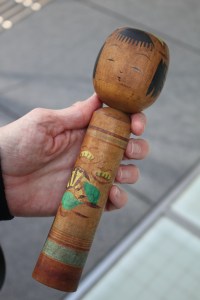
We started going to this market several months ago in search of Kokeshi Dolls for my collection. The Kokeshi Dolls are wooden dolls that are made by turning wood on a potter’s wheel or a lathe. They have a very simple design without arms or legs, and it is said that they were originally made in northern Japan to be sold at the hot spring onsens (public baths). I have collected several of these dolls, and we often go to the flea markets looking for more dolls. They are really pretty inexpensive, and I like to see the different designs and faces painted on the dolls. Here is a link to Wikipedia if you would like more information:
But the flea markets sell much, much more than just Kokeshi Dolls. There are all kinds of items available — from here in Japan, and from abroad. It is an eclectic mix of items, and I guarantee you will find something there that you like. Even if you don’t buy anything, it is a fun way to spend a sunny Sunday afternoon in Tokyo. Following are more photos from our trip to the flea market this past weekend.
There are racks full of used silk kimonos, yukatas, happi coats, robes and jackets. Many are handmade, and cost ¥1000-¥2000 or less! ($10-$20)
Interesting collectibles…
Dishware — including beautiful ceramics, and cast iron teapots.
Toys, stuffed animals — “Peanuts” and Snoopy are very popular here.
How about old record albums, and posters?
Or… a one of a kind sculpture, mask, or figurine?
And… when you get hungry… There are plenty of food options around nearby.
And one last photo — of the newest addition to my Kokeshi family. Her paint is a little chipped, and the wood is somewhat darkened with age, but she has a lot of character… don’t you think?
I have neglected this blog lately. I am sorry… We have been traveling, and the blog just didn’t get done. Sometimes my husband travels to meetings and conferences with his job. I try to go if I can. We decided when we took this international assignment, that I would travel with him if possible. We won’t always be here in Japan, and when he goes back to his regular job in the US, he won’t have as many opportunities to travel.
At these meetings, there is often a spouses/accompanying persons group. I have gotten to know many of the wives and significant others and we have become friends. We look forward to seeing each other at the different locations where the meetings are held. Most all of us are expats in our various countries of residence. It is interesting to get together and “compare notes” about our experiences. Sometimes there is an arranged tour for us to go on, and there are also evening functions — dinners and receptions — that we are invited to attend.
This last week was a trip to the UAE — United Arab Emirates — at Abu Dhabi. This is, actually the second trip for us to the UAE. My husband was there for another meeting — at the same hotel — just over a year ago. UAE is an interesting place. A starkly beautiful country on the Persian Gulf side of the Arabian Peninsula. The country is largely desert, with most of the population living in cities along the coast. I have been to both Dubai and Abu Dhabi… both are sparkling, opulent, modern jewels in the desert. Everything is bigger, and richer, and more beautiful in the UAE.
The photo on the left was our hotel complex in Abu Dhabi… The Jumeirah at Etihad Towers. Most of the towers are residential, but one belongs to the hotel. All of these towers are between 65 and 75 floors. The other two photos show the view out of our window on the 31st floor. Abu Dhabi is building artificial islands just offshore. Most will be used for homes, apartments, and hotels.
These three photos were taken last year in Dubai. At the top is the Dubai skyline from a harbor cruise that we went on. The top right photo is the Burj al Arab… the seven-star hotel in Dubai ($2000+/night!) Bottom photo is the Burj Kahlifa, currently the world’s tallest building at 160 stories. Dubai has some of the biggest shopping malls in the world. One has an actual indoor ski slope, and another has an Olympic-size ice skating rink. (Abu Dhabi’s largest mall had an indoor trampoline park and a bowling alley.)
UAE has a very diverse population, from countries all over the world. A large percentage of the population are expats, working in UAE, but with families living elsewhere. English is commonly spoken, but also Arab languages. The right photo above is the Grand Mosque in Abu Dhabi at sunset, and the bottom photo is the Grand Mosque during the day… always a dazzling sight.
We had a very enjoyable trip to the UAE. The people were very kind and welcoming. The culture is fascinating, and the country is modern and progressive. We hope to have the opportunity to visit there again.
Leaving again tomorrow for another trip… another 10+ hours on a plane, and another week in a hotel… Talk to you when I get back!
Today I went with my husband to the embassy to pick up visas for a trip we have scheduled later this month. Most of the embassies here in Tokyo seem to be located in or near to Roppongi — an area of central Tokyo just west of the Imperial Palace area. Because so many of the embassies are located here, Roppongi, Azabu, Akasaka… are pretty much considered to be the expat areas of the city.
The subway ride from Shibaura to Roppongi is rather circuitous and clumsy (which is unusual for Tokyo) so we opted to walk the two miles there and back… stopping for lunch somewhere along the way. It was a chilly, rain-spitting morning here in Tokyo, but with umbrellas in hand, we set out. Picking up the visas was pretty easy, we just walked in, handed them our receipts, and walked right back out with our new visas. Now for lunch!
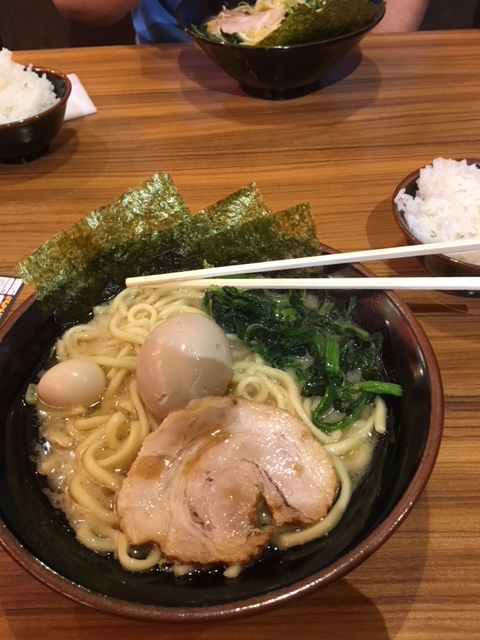
Ramen. Ramen is a very popular noodle soup dish here in Japan. Originally from China, it has become embedded into the cuisine of Japan. You can barely walk a block without seeing at least one ramen shop… ラーメン (in Katakana)… or らーめん (in Hiragana). Ramen has become the quintessential fast food/quick lunch in Japan. What can be better than a steaming bowl of savory broth, noodles, and toppings on a cold, wet, winter day?
Our usual “neighborhood” ramen shop — thicker noodles than some shops, and a quail egg!
Please don’t be thinking of those dried up little noodle bricks you used to reconstitute and eat when you were in college. Yes… you can buy that kind of ramen here too, in all the supermarkets and conbinis (convenience stores). The ramen shops, though, can give you a wonderful steaming bowl of noodles for anywhere from 500¥ to 1000¥ — depending on extras and toppings, of course. (From $5 to $10 US.)
Our “favorite” ramen shop in Shibuya — This one has pork, egg, veggies, and yuzu zest on top.
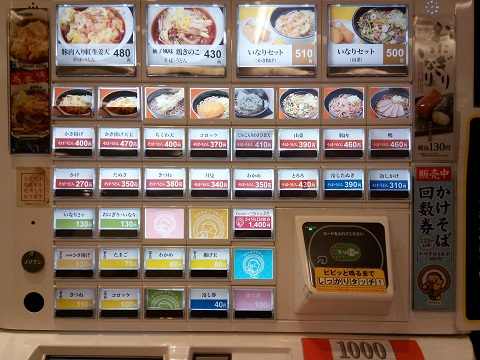
A lot of the noodle shops — ramen, soba, and udon — have ticket machines at the entrances. When you go in, you put in your money, push a button, and out pops a ticket that you give to the wait-staff. They direct you to a table, bring water glasses (pitcher on the table), and then bring you your noodles. Some places also offer rice to go with the meal, and there are always jars of condiments on the table to make your bowl of noodles just the way you like it: pickled ginger, chili oil and pepper, vinegar, shredded long onion, garlic, and sometimes different types of shredded seaweed.
Same shop in Shibuya, but with a piece of fried chicken added.
Pretty much, you can walk into any ramen shop and end up with a delicious meal. Sometimes, however, it can be a bit of an adventure. Today, for example, our ticket machine was all in Japanese (of course), but did not have any pictures to help us decipher the different selections. We could read some of the Japanese, but as the line was backing up behind us, we just decided to wing it and press a button. I knew I was getting a bowl with pork cutlet because I could read “tonkatsu” on the button, but that is about all I had a chance to translate.
This ticket machine has pictures to help guide your selection… And, you can pay using your Suica (transit IC) Card!Very much like the machine we used today… take your best guess…
Regardless… It turned out fine. I got my bowl of “shio” ramen — ramen in a salt-based broth — and my husband got his “shouyu” ramen — ramen in a soy-sauce-based broth. Both delicious, both warm and steaming and filling.
They say the reason that fast food chains do so well is that people like to know what to expect when they order food. We all like the predictable… predictable selections, and predictable quality. People here are no different. But, “fast food” noodle shops here all seem to provide a predictable and dependably delicious meal… no matter which shop you go to. Certainly, there is enough variation for everyone to choose a favorite, but in a pinch, you know you can always swing into a convenient noodle shop for a tasty lunch.
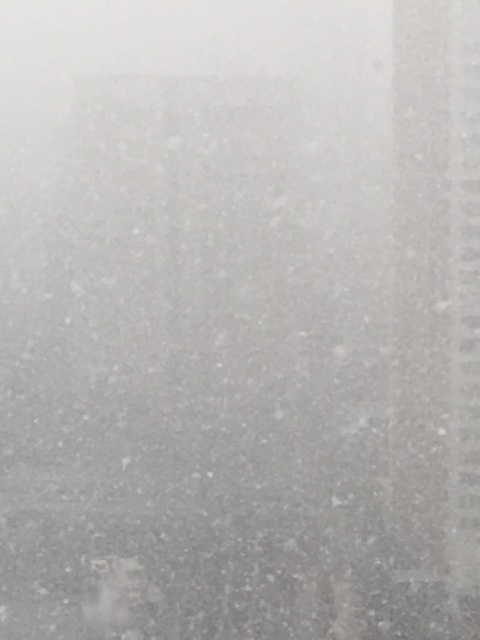
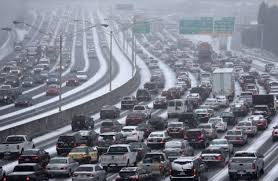
Near blizzard conditions outside our apartment window.
Remember “Snowmageddon 2014” — the winter storm that blew through Atlanta and paralyzed the city for a week? A few inches of snow and a glazing of ice during the middle of the day, and everyone trying to get home at the same time, caused an unprecedented gridlock on the city’s roadways. Thousands of cars were stranded, people abandoned their vehicles, workers were stuck at work, children spent the night at schools — or worse — they slept on school buses stuck in the traffic. My husband spent the night at his office.
Part of the problem with that storm was that it ended up being worse than expected, and that everyone waited too long to finally decide to cancel school and work, resulting in too many people trying to get home at the same time. But also… because this kind of weather occurs so rarely in the South, they just are not set up to deal with it.
Tokyo had their own version of “Snowmageddon” this week. Snowy weather is a rarity here in Tokyo, just as it is in Atlanta. The mountains to the west tend to stop most of the storms, and temperatures don’t often stay below freezing for very long, even in the winter. Sometimes, though, everything comes together just right, and we do get a big snowstorm.
As in Atlanta, Tokyo isn’t equipped to handle snow removal and road treatment. The biggest advantage that Tokyo has, however, is that there are far fewer cars on the roadways because of their mass transit system. Yes — some people do choose to drive cars to work, but parking is hard to find, and expensive. Trains and buses can take you anywhere in the city, and the cost is much less than driving and maintaining a vehicle.
The snow started here early in the day, but with temperatures hovering just above freezing, it took quite awhile for the snow to begin to accumulate. If the temperatures had been a few degrees colder, the snow would have piled up quickly. Officially, our part of Tokyo got 23 centimeters of snow — just over 9 inches. By mid afternoon, offices were closing and workers were heading home, hoping to get home before the trains got overly crowded. My husband walked home from work through 3 inches of slushy snow.
The snow can certainly wreak havoc with the transit systems too. Roads were slick and buses were affected. Trains were more crowded, and snow on the tracks can cause delays and cancellations. Heavy snow in other areas outside of Tokyo, caused some cancellations of Shinkansen and regional trains. Slick runways caused delays and cancellations at both of the Tokyo airports.
All in all, though, it wasn’t really much of a “snowmageddon.” I can see one of the highways from our apartment window, and there was never any gridlock. The cars that were on the highway — not many at all — were traveling slow, but not stopped or stuck in traffic. The snow ended around midnight, and overnight the temperature edged up a degree or two above freezing, so that things were beginning to melt again by morning. The sidewalks were still slick and slushy for my husband’s “morning commute” to his nearby office. And now — two days later — almost all of the snow is gone.
Maybe it isn’t fair to compare the two cities on this kind of event. The conditions were not quite the same, and — yes — some workers here didn’t make it home that night because their trains were cancelled. (I saw a news story that showed the restaurant/bars — Izakaya — and capsule hotels in the Shinjuku and Shibuya areas of Tokyo were very busy that evening!)
It would be impossible to “retrofit” Atlanta with a mass transit system comparable to the one here. Tokyo has the most extensive urban rail network in the world, and rail is the primary mode of transport throughout the metro area. This system has been around for a very long time, and the Tokyo of today couldn’t exist without it. But, though I miss a lot of things about living in Atlanta, the traffic/gridlock is not one of them. And… when we finally return to the ATL, we will certainly miss the convenience and efficiency of the transit system here.
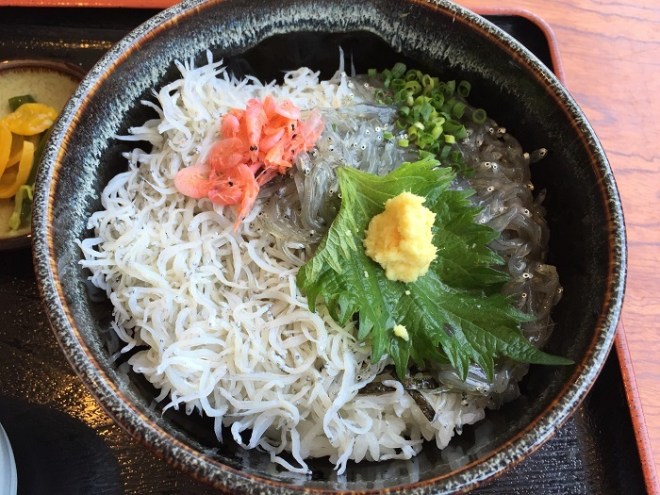
While we are on the subject of food… We have discovered many interesting and new foods since we have lived in Japan. One of the most unusual is shirasu. Shirasu is also known as “whitebait” — and is the juvenile form of several fish species, including herring, anchovies, and sardines. These “baby” fish are harvested in large numbers from local coastal waters — including Sagami Bay southwest of Tokyo.
We first tried these tiny fish — usually only a one or two centimeters in length — when we attended a dinner at a local restaurant. When they brought out a salad, there were these tiny white “things” sprinkled on top. They were tender, and tasted mildly “fishy” and salty, and were not unpleasant at all. On close-up inspection, we found that they were in fact, tiny whole fish… head, eyes, tail, fins, and all!
In the supermarket, they sell plastic containers of these tiny fish — most of them cooked (boiled), but some raw, or dried, and they are relatively inexpensive. I have never actually bought these from the store, but plan to soon try my hand at making shirasu-don myself.
“Don” in Japanese means a bowl of rice. So, shirasu-don is simply a bowl of rice with shirasu on top. Usually there will be assorted vegetable or seaweed toppings, and grated ginger as well. Sometimes it will be served with fish roe or raw fish (sashimi) too. And a complete set meal –“teishoku” in Japanese — will be served with miso soup, and Japanese pickled vegetables — “tsukemono.”
We recently took a short day trip to Enoshima Island while our daughter was visiting, and stopped in at a local restaurant for their signature dish — shirasu-don. We enjoyed it very much. It was delicious — once you get past the knowledge that you are eating baby fish. Totemo oishii desu!
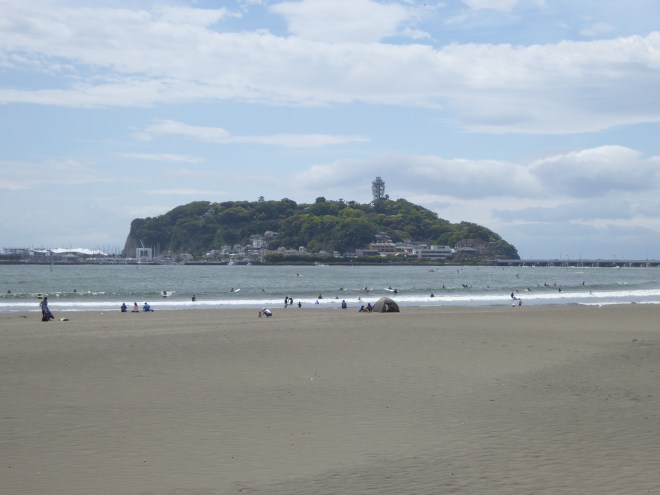
Enoshima Island — A short train ride down the coast from Tokyo. Enoshima, in the summertime is the quintessential “beach town” with surfing, swimming, and sun-bathing. The view from Enoshima Island. In winter, there is a beautiful view of Mt. Fuji from the island. In summer, the coastal haze and humidity usually obscure views of the mountain.
Apartments in this area of Tokyo — and actually in all of Japan for that matter — are pretty small by US standards. Space in Japan is at a premium, and the Japanese are used to having much less personal space. Our Tokyo apartment is 53 square meters — about 570 square feet. It is classified as a 2LDK… 2 bedrooms, with a combined living-dining-kitchen space. My kitchen here is just a corner of our small living room. We have a sink, small dormitory-sized refrigerator/freezer, and a cooktop combined with a small fish grill/broiler. No oven.
This is pretty typical for Japanese apartments. The Japanese traditionally don’t do a lot of baking, so ovens are not usually included in these small apartments. At home in the US, I did bake. I made cakes, cookies, pies, bread… and pizza. We are rather fond of pizza actually, so this has taken a little adjustment. Sure, there is pizza here in Japan. There are pizza restaurants in our area, and pizza delivery everywhere. Little pizza scooters deliver pizza from many of the popular US franchises — Dominos, and Pizza Hut — as well as local pizza restaurants.
But… to make a pizza here in our apartment has required a bit of creativity. I tried at first to bake a small pizza in the fish grill, but a broiler just doesn’t do the proper job. I make bread dough here, and use it for steamed buns cooked in my wok. I have even tried baking bread in my rice cooker (and this actually works… as long as you don’t try to make too big of a loaf.)
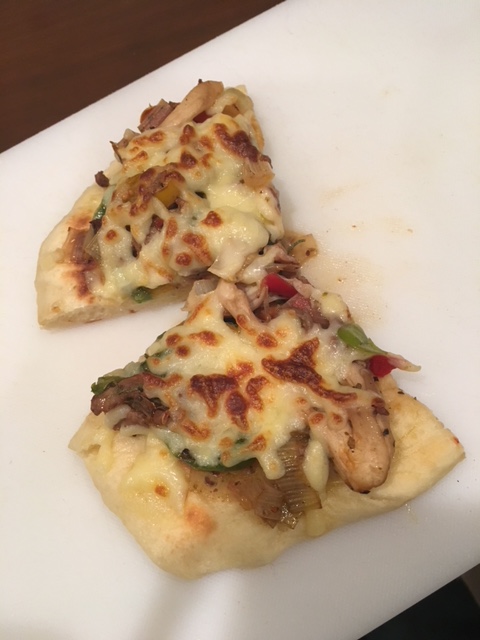
Anyway… so, how I finally solved the pizza problem, was to pre-bake the dough as a flatbread in my frying pan. Once it is cooked on both sides, I put on the toppings and cheese, and finish it off in the fish grill/broiler. This results in a reasonably decent homemade pizza. Maybe not as good as the local pizza restaurant that we go to (that actually has a huge and hot brick pizza oven) but not bad at all. Yum.
There are a lot of things to adjust to when living in a foreign country — some big things, and some pretty small and insignificant things, like… pizza. Learning to adapt the lifestyle we were used to, to fit with this lifestyle has been a fun part of this adventure.
When you visit a foreign country there is always a long list of things to do and see. Tokyo — and all of Japan — have many touristy activities and sites that I would recommend to anyone coming here for a visit. It pretty much runs the gamut from cultural/historical things like temples and shrines, purely tourist sites like Tokyo Tower and SkyTree, nightlife, restaurants, trendy areas, amusement parks, and shopping spots.
Having lived here for two years now, we are pretty much past the tourist things, and have settled on our favorite activities that we like to do in our spare time. But, occasionally, we do still go for the touristy stuff, and MariCars are most definitely on that list.
MariCars are “Mario-themed” street-legal go-karts that you can drive around Tokyo. They have several locations around the city, and several tours available, daytime and nighttime. The carts are easy to drive, and easy to maneuver, even in Tokyo traffic.
When you go in, you show them your driver’s license (or International Driving Permit, in our case) and fill out the waiver forms — English available. Once done with the paperwork, you choose a costume to wear, and have a short instructional lesson with the driver of the leader car. They have GoPro cameras available for rental. All you do is bring in your own micro SD card.
It is a fun, silly, and interesting way to see Tokyo! More information can be found on their website: https://shinagawa.maricar.com/
Lots of costumes to choose from, and a “chase vehicle” for those in your group who want the experience without actually driving one of the carts. Daytime and nighttime tours available in many of the popular areas of Tokyo.
Two years ago today, my husband and I stepped off the airplane at Narita Airport to begin our — at that time — two year adventure as American expats in Tokyo. Back then, two years seemed like a long time, and we thought it would be plenty of time to get to know this country and this culture, and these people, and then be ready to step back into our life in the US.
After that first year flew by so fast that we hardly had a chance to say “Ohayou gozaimasu” (good morning), we were offered — and agreed — to stay for a third year. Now, as we have reached the end of our second year living in Tokyo, Japan, a few notes and observations come to mind:
We did not take the decision to come here lightly. We knew it would be difficult — and it has been more difficult than anything we have ever done together in our marriage — but also, we had no idea just how amazing, rewarding, and fulfilling this experience would be. This culture is fascinating. The Japanese people are kind, generous, and welcoming. We have learned so much in the past two years. And not just about Japan… about ourselves as well.
The things I miss most about “home”… my pets. My kitties. I know, you expected that I would say my kids, and I DO miss seeing them in person, but I am in contact with them via the internet just about every day. Our children are grown now, with jobs and significant others and busy lives, and they are spread out over the country. Even if I were at home in Georgia, I wouldn’t see them more than a few times a year. My cats, though… I can’t talk to, cuddle, or hold. When I visit back home, they shy away from me now. That hurts.
I do miss my house, but I am enjoying this big-city-30th-floor-apartment-with-a-view-life. I miss my car, but… I don’t really miss driving my car, so why do I miss the big hunk of metal sitting in my garage in Atlanta? I am perfectly happy riding trains and buses here in Japan. I would happily ride trains and buses in the US… IF that were EVER possible.
I used to miss my “stuff” in my house at home, but not so much anymore. I have lived for two years without most of it. I found out that we can very happily get by without all that “stuff.” I think when we do go back “home”… there is going to be some serious down-sizing of the “stuff” pile.
Yes… sometimes I still do get homesick and wish I was back home. The thing is, as much as I sometimes would like to immediately go back to by life THERE… I can’t help but think about all the things I will miss about being HERE. Even though I am very much a “foreigner” here, I find myself feeling very possessive and protective of my temporarily-adopted-country. I can never be Japanese, but I love living Japanese… lol.
The Japanese language… is very difficult to learn. Lol… I know I have said that many times before, but the more I learn, and the more I study, the more I realize I still have to learn. You see, the language is not just words. It is a culture. A culture that is still very new and unfamiliar to me even after two years here. I can memorize word lists and verbs, and learn hiragana and katakana, and even learn some of the kanji, but this language is so filled with the culture and history of this place that I will never be able to learn it all. That doesn’t mean that we haven’t made significant progress, because we certainly have. It just means that it is a lot more complicated than we realized.
Japan has changed me. The conundrum that is arising in us is whether we will ever be able to happily go back to that life we had before. I don’t know… It is perplexing visiting back home (as we did over the holidays). I almost feel like I have two lives, and I, in some ways, feel like I am two different people. I am different here from the person I am there. It is hard to explain, but sometimes I am just not sure which life/person I prefer.
A conclusion. New experiences are good. Grab as many as you can! Sometimes new experiences take you outside your comfort zone and make you squirm. Do them anyway, and realize that the discomfort is much more interesting than the same old, same old. Change is inevitable. Roll with it. Embrace and live life as fully as you can, for as long as you can.
What will this next year bring? Certainly some travel. A couple of trips “home” and some visitors from there. And… everyday life in the biggest city in the world. How will we feel after our third year here? Only time will tell…
There are a multitude of things to do when you live in Tokyo. But every so often, it’s nice to get out of city. An easy day trip from Tokyo is Enoshima.
Enoshima is a small island off the Shonan coast, about 70 km from Tokyo. There are a number of ways to get there. Not having a car, we chose the train.
Specifically, the Tokaido Line from Shinagawa Station to Ofuna, then the Shonan Monorail to Enoshima. It’s about an hour and a half ride in total, at a cost of just under 2000 yen, round trip.
Exiting the monorail at Shonan-Enoshima Station, it’s a short walk to the Enoshima Bentenbashi Bridge that connects the island with the mainland. The bridge is often crowded with people walking to the island. On a clear day — like today — there is an amazing view of Mt. Fuji. That sight alone is worth the trip. But there is much more ahead on the island.
After exiting the bridge, there are the ubiquitous souvenir shops and restaurants all leading uphill to the first of three Enoshima shrines. The Shinto shrines are a gathering place for worship, and a place of beauty and interest for those not of the Shinto religion.
The walk up and around the island is a pleasant one, but be ready for some steep steps up and down. In addition to the shrines, there is the Enoshima Samuel Cocking garden, and the Enoshima Sea Candle (Observation Lighthouse). While near the top, a small cafe offers visitors tako senbi – a light cracker made of Octopus that is a popular snack on Enoshima. The idea of an Octopus cracker may be a stretch for some Westerners, but give it a try– it is actually quite tasty.
Steps leading down the mountain take you to a vantage point offering a spectacular view of Sagami Bay. Normally, the Enoshima Iwaya Caves are open to visitors. A recent typhoon caused damage, and the caves are closed for repairs.
Looking around Enoshima makes for a pleasant and interesting day — a great day trip from Tokyo.












 Four Years in Japan ... and now Three Years in London