Time flies…

2016-03-14a

Yes… Time flies, and we have been living here in Tokyo for going on 10 months. We knew the time would go fast… too fast. Our two year assignment will be over before we are ready for it to be over, I’m afraid.

It has been a couple of weeks since I last did a blog post…  Again… time gets away from me. The routine of daily life gets in the way. But, I have just a few somewhat random things to talk about in this post today:

  • Even after almost 10 months living here, some days I have to really force myself to get out the door.  It can be very stressful living in a culture where you don’t know the language well. Simple little tasks like paying bills and going to the supermarket can become nerve-wracking encounters of miscommunication. Some days I am just not up for it. Yesterday, I stayed in all day. Sure…  it was pouring rain until mid-afternoon, and by then I had settled into studying my Japanese. I find it is best if I can get myself out the door early. Kind of sets the tone for the rest of the day.
  • This morning the sun was shining and I went out for a run. Starting out with fresh air and exercise always makes the day better. Five miles along the canals, watching the ducks and cormorants, watching the boats on the canal, and “people-watching.” It still seems weird to me that I am living in the most populated metro area in the world, and I can still be somewhat close to nature. In this crowded and busy city, we have managed to find a beautiful and quiet place to run and walk and commune with nature. Not all of Tokyo is this peaceful… lol.
  • Ok…  I have mentioned this many times, but the Japanese people are really NICE people. They have elevated “nice” and “polite” to an art form. Honestly. The US could take a few lessons. (No offense, but really.) Today I went to the supermarket. They are always so nice, and they seem to genuinely appreciate their customers.  They are polite, friendly, helpful, and engaging… at least as much as they can be with this non-Japanese-speaking foreigner. The checker today apologized profusely when something rang up wrong, and she even carried my grocery basket to the bagging table for me.
  • That said… when I walk along the streets — at least here in Tokyo — sometimes I feel invisible. No one looks at me or makes eye contact with me at all. This used to bother me a lot. I almost felt rejected… like they didn’t approve of my being here. It would be easy to take it personally, but then I noticed they treat each other the same way. I think it all goes back to “meiwaku” again (see previous blog post.) The Japanese people are brought up to be kind and respectful to each other, and to be very careful not to offend or interfere with the people around them.
  • And… this shows up in their language. I am struggling to learn Japanese, but I have learned enough to notice this. For one thing, what I am learning is the “polite” form of the language. They have an informal form, but that is usually reserved only for family members and close friends. Polite form is very important. Also… when they need to refuse something or say “no” to something, they do it very indirectly. It is considered rude to directly say “no” to something. You have to do it in a very gentle and apologetic way. “Chotto… sumimasen…”
  • Sunday morning, my husband and I went out for a run. Many of the sidewalks here are divided into pedestrian lane and bicycle lane. Bicycles usually ride on the sidewalk and not out in the street. Anyway… we were running along in the pedestrian lane and came to a blind corner blocked by a construction wall. As I came up to the corner I was almost run over by a women on a bicycle who had “cut” the corner and veered into the pedestrian lane. It was a good thing we both had quick reflexes, or we would both have been sprawled on the pavement. She profusely apologized… “Sumimasen, sumimasen… gomenasai!” (I’m sorry!) In another culture, it might have been easy to get angry and snap an unkind response. But here… no…  As frightened as I was by almost being run down, I just smiled and bowed to her (at a loss for words again.) I find this culture is rubbing off on me… and I like it.

Lost in Translation… yet again…

Life anywhere is full of little problems that we have to deal with… the little headaches of daily life.  *sigh*

Last week while we were away in South Korea,my Japanese iPhone was turned off and stowed carefully in the bottom of my backpack. When we travel, my US phone which has free data and text messages…  and $0.20/minute calling (ala our T-Mobile plan) is what I use. In retrospect, I probably could have gotten by with just the T-Mobile phone for these two years in Japan, and not gotten a Japanese phone at all…  but I thought (at the time) that I would need a phone for calling here in Japan. So I have been carrying two phones…  my US Samsung phone for communicating back home, and an iPhone for use here.

Anyway… When we got back to Tokyo, I turned on my iPhone and it immediately said it needed to do an update.  Ok… I have done a couple of updates in the past few months, and all went smoothly. This time, however, after a few minutes, my phone said that it needed to be plugged into iTunes because the update had failed. Long story short, my Japanese iPhone failed to update, and though I have tried numerous things, numerous times (suggested by the IT people at my husband’s office, and from websites found on Google), it just will not update. It just gives me error codes.

So, today I went to the SoftBank Store — my cell service provider, and the place I bought the phone. “Eigo ga wakarimasu ka?” I said, and before I even got the words out, the guy at the counter crossed his wrists into an X, and said, “Eigo no” (“English no.”)  I still tried to talk to him, and showed him my phone, and told him the update failed. He seemed to know the word “update”, took the phone from me and turned it on. Then he handed it back and said “Apple su-to-a” and handed me a map — which was written entirely in Japanese.

Well… next stop, the Apple Store. I hope I have better luck finding someone who can speak English with me. I am still learning Japanese, and I am sorry I can’t communicate better than this…  I really am trying.

As I said…  I know life is full of these kind of little problems, but it would be so much easier if I could speak Japanese. I’m enjoying this time living in Japan…  It is just that some days are more difficult than others.

A “red umbrella” day in Tokyo

HE says:

Today the rain came. Thanks to typhoon Malakas, all of Japan is getting a drenching.

Rain isn’t uncommon here. In fact, it rains a lot. And because of that, Tokyo is known as the umbrella capital of the world. Everyone here owns an umbrella. They have elevated umbrella ownership to an art form. When it rains, the masses turn into masses of umbrellas. I even saw a lady tonight riding a bicycle with a child seat in front, and another in back, and the child in the back was holding – yep, an umbrella in motion.14192142_10210425024960905_1094324509826253178_nc

Most people – particularly businessmen – have dignified black umbrellas. Or stately royal blue. Some even have rich hunter green bumbershoots. And of course, there are the ubiquitous transparent umbrellas that you can buy for 300 yen at any convenience store.

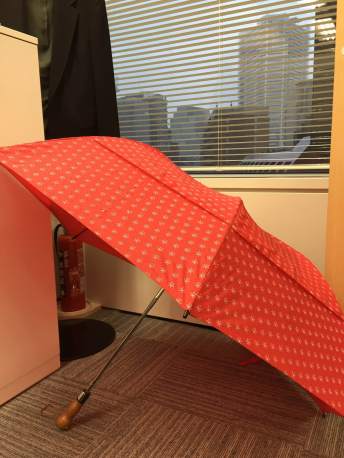
I, on the other hand, don’t conform to conventional umbrella wisdom. When the big rains come, I pull out my secret weapon – the Big Red Umbrella.

It’s not that I don’t stand out enough in this mostly-Asian section of Tokyo. But with my Big Red Umbrella, I am truly hard to miss. I think it may be the only umbrella of its kind in Tokyo…and perhaps all of eastern Asia.

img_0597It isn’t that I’m trying to be a rebel or anything. It’s just that this is the only serious umbrella that I own. It is, as the name implies, Big. And heavy-duty, so it resists the winds that often come with the rain. It keeps me dry(er) and serves me well. Even if it does make a fashion mis-statement.
As far as I know, deploying a red umbrella isn’t a major social faux pas in Japan. It’s not like the umbrella equivalent of having a scarlet “A” emblazoned on my forehead. It’s just – distinctive – in a culture where being distinctive isn’t always desired.

One day, I may invest in a truly dignified, culturally compliant kasa. But for now, I’ll risk being a fashion outcast and stay a little dryer – with my Big Red Umbrella.

SHE says:

Yes… The rains came… and it is still raining tonight. And what HE says is true. In the rain, Tokyo becomes a sea of umbrellas. Everyone has an umbrella… rarely do you see people even sharing an umbrella. Small children dutifully follow their mothers carrying their own child-size umbrellas. School-children run along the sidewalks under their own colorful umbrellas, and even bicycle riders — steering one-handed (!) ride by under umbrellas.

I, myself, have my trusty Totes (brand) super-compact, purse-size umbrella that I purchased years ago at Target in the US. That umbrella has gone many places with me, and has served me faithfully through many a surprise rain shower. It is not super sturdy as that Big Red Umbrella my husband carries… in a sudden gust of wind, it will inevitably turn inside out… but the greatest advantage of my little collapsible umbrella is its compact size, allowing me to carry it everywhere so that I am never without my trusty umbrella.

You see… here in Japan, umbrellas can be used for more than protection from the rain. In the summer, some (mostly women) use those handy umbrellas for shade. Tokyo, with its unbearable heat and humidity begs one to seek shade wherever it can be found. I also have tried using my trusty $8-from-Target umbrella for protection from the intense Tokyo sunshine, but alas… it is not the proper kind. Yes… it will protect me from the sun, but, I have found, because of its black color (with polka-dots… lol) it tends to absorb and concentrate the heat from those rays of sunshine. Under my umbrella, the sweat pours down my face.

Japanese women have special sun umbrellas that have a silver metallic coating on the inside to prevent the heat from penetrating to the user. Expensive… yes. Compact… not so much. But… multipurpose and protective from both rain and sun.

In the US, a lot of people refuse to carry umbrellas, preferring to dash through the rain from place to place without. But here in Tokyo, umbrellas are a  necessary  accessory to everyone’s wardrobe.

The love and hate of travel

One of the opportunities of my job assignment in Tokyo is the ability to travel to various places throughout the world. I’ve discovered that I love to see new places…and sometimes hate to travel to those places.

img_1375

We just returned from a trip to a business meeting in Budapest. Took the opportunity to fly to Vienna, then take a hydrofoil on the Danube to Budapest. The flight to Vienna wasn’t so bad, aside from some delay going through customs in our connecting flight in Amsterdam. The boat trip on the Danube was great – wonderful weather, and a relaxing and interesting trip along the river.

Budapest is an interesting city. Amazing, if somewhat tragic, history. Beautiful architecture. We toured the city, saw a lot of interesting things, and managed to enjoy a street festival. The weather was warm, with just a little rain on one day we were there. It is always fascinating to see how other people live, and it was eye-opening to learn of the struggles people in Budapest have had throughout history.

Being in a new place is always a rewarding experience. Getting to and from, not so much. The return trip was frustrating. What should have been an easy 2-hour layover in Amsterdam turned out to be a nail-biting close connection, thanks to a huge line at the immigrations area. The flight back on KLM was one of the worst I’ve had recently. Miserably hot cabin, awful food, and the seat in front of me that reclined far further than it should have. I’m sure the airlines try their best to make a 10-1/2 hour flight pleasant, but on this one they failed – big time.

Nonetheless, the price of seeing new and distant places is the time and effort it takes to get there. One day, maybe travel will become easier. I look forward to that day. Beam me up, Scotty.

Pricele$$

img_0863

Can you stand one more post about grocery shopping?

Tokyo has a reputation for being an expensive place to live… And, certainly, I think this is very true. But sometimes, I am surprised by prices I find at the grocery store. I think it seems like we spend a lot more here, just because we shop more often, and we pay with cash. I think the food prices are higher here in central Tokyo, but not that much higher than at home in the US. At home I shop maybe once or twice a week, and pay with the credit card. When paying with a card, I think it is easier to forget just how much you are spending (the reason that so many people end up getting into so much credit card debt.) Paying with cash makes you think so much more about how much you are spending… “Do I have enough cash to buy this?”

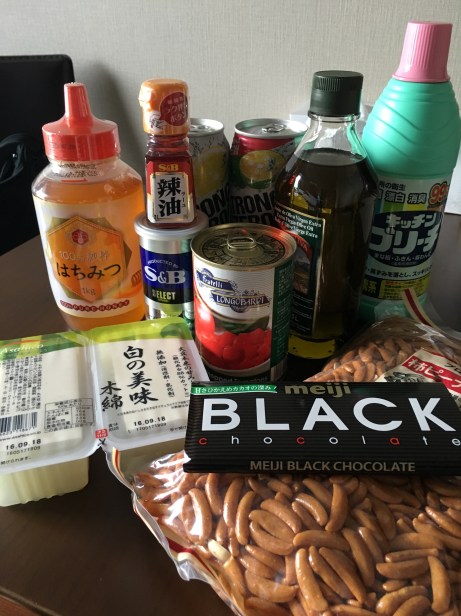
Anyway… This photo shows what I bought today at the supermarket (plus a bottle of wine I forgot to put in the photo.)  It ended up being about 3500 yen… roughly $35. I bought a few pricier items today…  things I don’t often buy, so it was more than I usually spend in one trip.

img_0867

Some prices here are pretty close to what they are at home.  For instance, this 0.5 liter bottle of olive oil was 498 yen… a little less than $5. Not too out of line with the US price. (*If you want good prices on olive oil in the US, go to Trader Joe’s! I miss my Trader Joe’s…)

On the left here is chili oil! I have been looking for this for quite awhile, actually, and finally found it.  This was pretty inexpensive here… about 180 yen. The tofu (on the right) — yes, we eat tofu, and we LIKE it — is really cheap here. This two-pack costs about 80 yen here.  Much cheaper than at home in the US. We probably eat tofu 2 to 3 times per week.

img_0866

The big price surprise for me today was this monster-size bottle of honey! One kilogram(!) for 498 yen. Wow! This size container at home would cost me about 3 times that price. Of course, once I got home with it and used Google Translate on the labeling, I found out that it came from China. Hmm… with all the bad press about Chinese food products lately, that sort of disappointed me.  But… knowing how strict the Japanese are about food additives, chemicals, and preservatives, etc… It will probably be ok.

So…  yes, it is expensive living here, but I think most big cities are that way. Our son just moved to New York City, and if you compare the rents between here and there, NYC (Manhattan, anyway) is significantly more expensive than Tokyo.  I haven’t asked him about grocery prices yet, but I would expect them to be the same way.

For us, it is a trade-off. We are willing to spend a little more to live here right now, for the experience of living a life that is so different from anything we have experienced before. Soon enough, our time here will be over, and we will be back to our home in the US. This experience is pricele$$.

‘Tis the day after Fuji

IMG_1206‘Tis the day after Fuji,
The climb is all through.
We’re back home in Tokyo,
and I’ll just say, “whew”!

Our trip on the bus,
it went as expected.
A great way to travel,
no problems detected.

Got off at station 5,
the place where we’d start.
Nice man gave a briefing,
Said go slow, you’ll be smart.

The walk started easy,
nice and flat, smooth and such.
We thought, “this is simple,”
But soon, not so much.

IMG_1147
The trail started climbing,
as mountain trails do.
It was steep, rocky, difficult,
and went on and on, too.

A few hours later,
we reached our abode.
A simple mountain hut,
just a bed, food and commode.

Our sleep, there was little,
we were up around 3:00.
Joined hundreds of others,
climbing with lights, just to see.

The sunrise it was awesome,
a truly spiritual sight.
A time we’ll always remember,
for many a night.

But what goes up must come down,
and for us, that was true.
Coming down off that mountain,
Would be daunting — who knew?

The slope is so steep,
the trail snakes down the hill.
Volcanic rock, it is slippery,
Every step takes great will.

A few hours went by,
with slips, slides, and some spills.
But to the end we did make it,
This test of our wills.

Looking back on it now,
some muscles are aching.
Would I say that this trip
was an adventure worth taking?

I’d have to say yes,
absolutely, you bet.
Mt. Fuji is amazing,
a great challenge we have met.
P1010684


Fuji-san — in Retrospect

IMG_0815
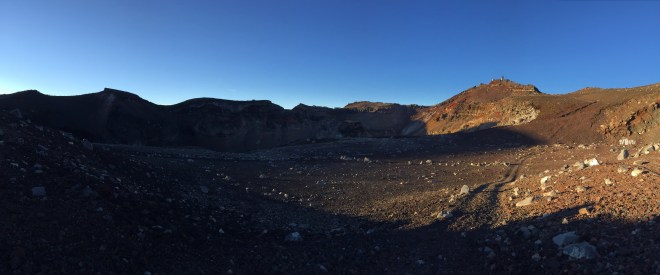
A pano view from our mountain hut. The evening shadow of Fuji-san as the sun was going down.

This is the “she” part of the blog team… The “he” part will write his own blog on our Mt. Fuji experience. We had a successful climb and we are now back in Tokyo… not much worse for the wear… some sore climbing muscles, and a few minor abrasions from close encounters with all that volcanic rock. It was a good trip.

But… to say “yes, we had a good trip” just doesn’t describe this experience at all. Yet, I can’t really go so far as to say “we had fun” either. This experience, certainly, is not “fun” in the classic sense. It is “fun” maybe in retrospect, but as I was working my way up and down that mountain, “fun” is not the word that popped into my mind. In fact, on the long and difficult descent (oddly… the descent from Mt. Fuji is definitely more difficult than the ascent — steep and slippery) I remember thinking how much I hated it. I was not having fun. But in retrospect, with the climb over and behind us, I did enjoy it in a bucket-list sort of way.

IMG_0800
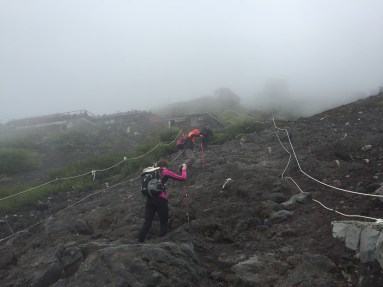
Looking up the mountain from one of the mountain huts. The trail was a series of rocky switchbacks to the top.

There are many things I learned from and about Mt. Fuji. First and foremost, the difference between hiking and climbing. Before our trip I mistakenly referred to it as “a hike up Mt. Fuji.” This is not a hike. This is a mountain climb. We have done lots of hiking. We have hiked all the way across northern Spain when we walked the Camino de Santiago. That was indeed a hike, a walk… we carried packs, we were on the trail for days and weeks. Fuji is different. We started the climb at an altitude of 7562 feet, and ended at 12,388 feet. Nearly 5000 feet of altitude gain in roughly 5 miles distance.

Before we started, we were advised to take it slowly and to allow our bodies to acclimate to the altitude in order to avoid the “mountain sickness.” My husband and I usually set a pretty fast pace when we are hiking. Forcing ourselves to slow down wasn’t easy at first, but it really did make a difference. We had absolutely no altitude issues with this trip. As you get to the steeper and rockier portions of the trail, and when the trail is crowded with people… all lined up to ascend a narrow trail … it was necessary to go slowly, and it paid off.

IMG_0781
There is water at Mt. Fuji…  Lots and lots of mineral water and hot springs… at the base of the mountain.

The second thing that we learned is just how dependent we are on water. We were advised to take at least 2 liters of water with us, so we bought water before we started. Mt. Fuji is a volcano. There isn’t much water available there. There are no natural water sources as you climb up. All the mountain huts along the way will sell you bottled water, but they do not have drinking fountains or tap water sources… at all. They have to carry all the water they use up from the bottom. The mountain huts do have flush toilets… And charge between 200 and 300 yen (about $2 to $3) for each use. They biologically treat all their waste water to be re-used to flush the toilets. There is no potable water all the way up the mountain. So you take your own, or buy it from the huts. [As a side bar to that… there are NO trash cans on Fuji. ALL of your trash — and empty water bottles must be carried down with you to take home.]

That also means… that after a long days climb when you are tired and dirty and sweaty, there is no water to bathe or even wash your hands. You have to use bottled water even to brush your teeth. The mountain hut we stayed in provided a sleeping dorm, a boxed dinner (with ONE cup of hot green tea), and a boxed breakfast with a small carton of tea. Anything else you want is extra. So… you resign yourself to being a little grubby, wearing your dirty clothes, and conserving your precious water for climbing the mountain. Oh… and the higher you climb, the more precious the water becomes. The price of bottled water doubled by the time we got to the top… lol.

But regardless, even with the strenuous climbing, and the discomforts involved, we DID (in some strange way) “enjoy” this experience… and hope to actually do it again. It was an amazing sight to see… and to be together with so many other people who wanted to experience “the mountain.” Difficult or not, it was well worth it.

IMG_0825
We left our mountain hut at 3:45 am to climb to the summit for the sunrise.
IMG_0827
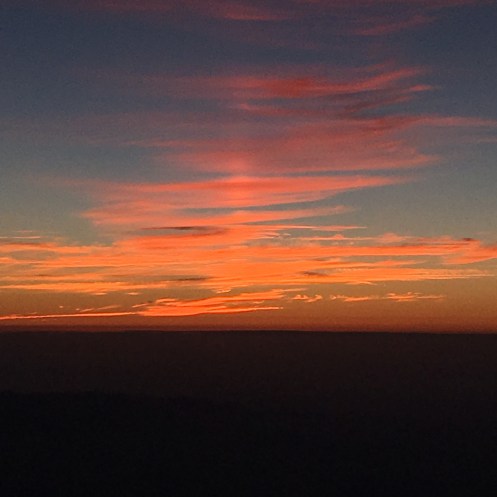
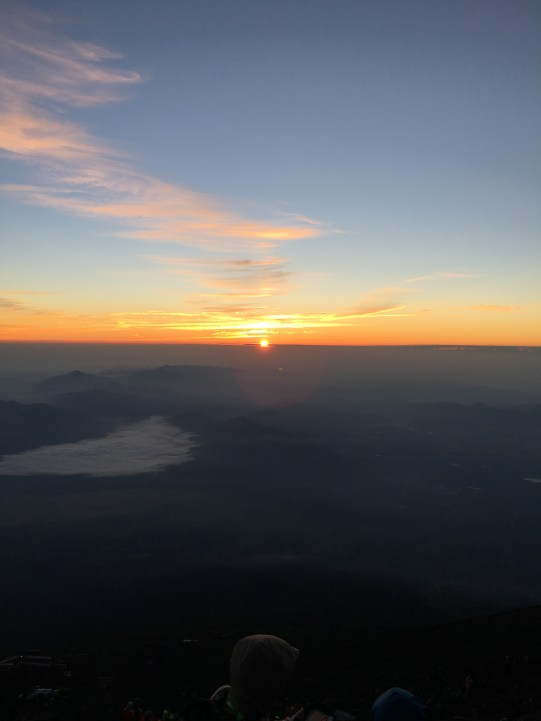
We were still 50 meters below the top when the sun came up… but everyone stopped where they were to sit and watch as the sun rose out of the ocean.
IMG_0835
Along the rim of the crater is a group of buildings and shops, and a Shinto Shrine. The buildings all have rocks piled on the roof. Winds are fierce during the winter. The hiking trails and mountain huts are only open between early July to early September. This year the trail closes September 10th. Snow comes early to Fuji-san.
IMG_0832
The morning shadow of Mt. Fuji as the sun rises over the crater.
IMG_0836
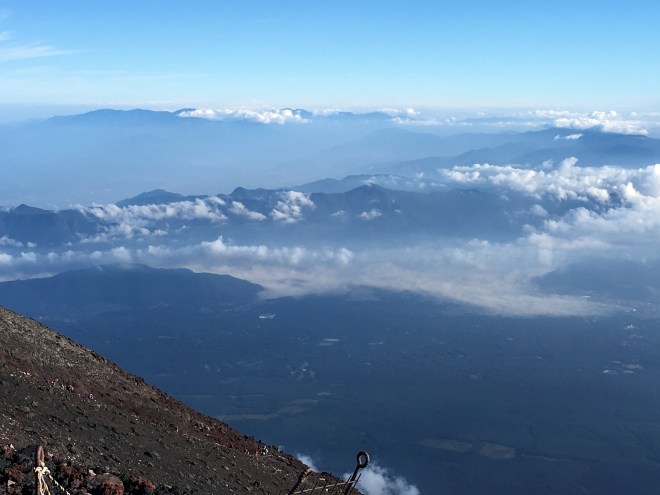
The view from the top. This time in the season, mornings usually start out clear, but the clouds move in early and obscure the view of the mountain. We hiked down from a sunny summit through a cloud bank below.

‘Twas the Night Before Fuji

2016-08-31 20.36.21

Twas the night before Fuji,
when all through the house,
the two of us were stirring,
yes me and my spouse.

The backpacks we packed,
crammed the hiking gear with care,
in hopes that the stuff that we need
will be there.

Early morning we’ll rise,
get up with the sun.
Take the train to the bus,
a couple hours, we’re done.

We start at station 5,
go walking toward the peak.
Hoping our legs stay strong,
and our pace isn’t meek.

By the end of the day,
our mountain hut we should see.
At 11,300 feet,
we eat, rest and …well, you know the rest.

Friday morning we rise,
it’ll be early and cold
When the sun does comes up,
the peak we’ll behold.

That’s it for now,
this story’s on hold.
More to come later,
to let you know how we rolled.


An Update on Grocery Shopping…

After 7 months living here in Tokyo, going to the supermarket has started to feel fairly routine. I still have trouble identifying some products, and still haven’t found some of the things I would like to buy, but I am getting used to the way it is done here in urban Tokyo.

This is a typical grocery store haul for me…  And I mean “haul” since I have to carry it at least a kilometer back to our apartment. This is just under 3000 yen worth of groceries. I would have liked to have gotten a couple more things on this trip — a bag of rice, for example (another 2 kg for the bag I usually buy) — but I had reached the limit of what I could comfortably carry today. Believe me, I have gotten pretty good at judging! It’s not pleasant carrying an overloaded grocery bag all the way home during the hot Tokyo summer!

The stores are all fairly small — small neighborhood places. They have small shopping baskets that you carry through the aisles, or you can put that basket into a little cart to wheel around the store. No giant grocery carts here. The aisles are narrow. When you go through the checkout, they load your groceries into another basket. Then after you pay (cash preferred!) you take your basket to a table and pack your own grocery bags to carry home.

I have three “nearby” supermarkets (Su-pa-) that I regularly shop:  two are about a kilometer away, and another is about 1.5 kilometers away. And… there are three more that I occasionally go to that are about 2K away. Just as in the US, there is no shortage of stores, it all just depends on what is most convenient. I shop different places depending on what I need to get. For the most part the prices are nearly the same, but I have found that one store or another will save me a few yen on certain things.

I have loyalty cards from some of these stores, so that I can accrue points toward future purchases, and as you can see in the photo, I now have a brand new reusable shopping bag! I brought 2 from home, but I like this new Hanamasa bag… I have found it is so much easier to carry groceries home with the reusable bag slung over my shoulder than to carry plastic bags in my hands. Plus… I can get more groceries in one trip. I have to shop 4 or 5 times per week anyway. I would rather not go to the store more than I have to.

Since most people in this urban area walk or ride bikes to the supermarket, products are packaged in much smaller sizes. Milk and juice come in 1 liter cartons, and eggs in 4 or 6 packs — although Hanamasa sells eggs in a 10-pack as well. Produce is all beautiful, but a bit pricey, and they will package much of it individually. Because of the small sizes, of course, you have to make several trips per week… and some people shop daily.

Even though we are learning Japanese, and I now can read both Hiragana and Katakana, I still have trouble reading the packaging. Most products are fairly obvious, but I still come home with some surprises now and then. There has been a bit of trial and error, and some experimentation, but most of the time I get the things I need.

We live — and eat — very simply here. No fuss. As I learn more about Japanese cuisine, and Japanese products, I expect to become a little more sophisticated with our diet here, but I think we are doing quite well considering how different it all is.  And yes…we are still enjoying the adventure…

The Challenges of Living Two Lives

This is the “he” part of this blogging team, resolving to be more diligent about posting in the blog. Today, some thoughts about living two lives.IMG_1107

When I took this 2-year assignment in Japan, I didn’t really appreciate the fact that I was signing up to live two lives.

One life is, of course, made up of the day-to-day tasks of living in a foreign country. Work consumes a lot of the weekdays and offers its own challenges and rewards. Seeing and experiencing the culture is a great experience. And then there are the more routine things…buying groceries…working out at the gym…paying the bills.

For the most part, this life abroad has been good. The people here are remarkably friendly and accepting. The city is safe and clean. And the culture is fascinating. Granted, there are “those days” in this life. Learning the Japanese language, for example, has been a mixture of challenge, frustration, and downright irritation for me. After one particularly difficult Japanese class last week, I felt absolutely disheartened. Fortunately, the feeling passed. For the most part, this life is good.

Then there is the other life. The one back home.

Going into this, it seemed simple enough. Make the proper arrangements, and go away to live for a couple of years. The things back home would be on hold, and would pretty much take care of themselves. Keep in touch with video calls, and the occasional trip back. No fuss, no bother.

Well, not quite.

In a way, it’s great having the reassurance that there is something waiting back in the other life. People we love. Nice house. Nice car. All that we enjoyed before this adventure began.

But there is also the difficulty of having that second life. Loved ones experience major life changes, and we can share them only from thousands of miles away. Damage happens to the house, and to the car that has to be taken care of (fortunately, nothing serious). We feel concern about the direction our native country is going, and what it will be like when we return.

All this to say, having two lives can be complicated. Sometimes, all is good in both lives, and it’s a great day. Other times, there are problems or difficulties in one or both of the lives, and things look gloomy.

Is it worth it, signing on to have an additional life? Yes, I would say so. There are great opportunities in living a new and different life, and they outweigh the challenges.  The key, I think, is to let go of the things you can’t control (which, actually, turns out to be most of it). You plan what you can, and learn to adapt to the rest. It isn’t easy, and it isn’t for everyone. I’m still learning. But the rewards for the effort, I believe, are priceless.