Shabu Shabu…

shabushabu

Last night we went to dinner with some of my husband’s co-workers from Atlanta who are in town this week for a meeting. Another one of the meeting attendees who is native Japanese took us all to a traditional Japanese restaurant for Shabu-shabu. Shabu-shabu is a meal of thinly sliced beef which you cook at the table in a pot of boiling broth.  I have had Shabu-shabu once before on a previous trip to Japan. It is an expensive meal because of the high quality of the beef used for this cooking process — so we won’t be doing this very often — but it is very delicious, and a fun way to spend an evening.

The restaurant was set up with individual rooms and each had a low table large enough to accommodate a group of 8 to 10 persons. We removed our shoes in the entryway (slippers were available) and then sat at the table. Traditionally, the table is low to the ground and you sit on cushions on the floor. This restaurant — probably to accommodate non-Japanese who are not used to sitting on the floor — had what at first appeared to be a low table, but then there was a well below the table where you could put your feet.

The table had two gas hot plates. Each had a pot of water with a kombu leaf in it. While we waited for the water to come to a boil, they brought plates of salad and appetizers — and beer and sake, of course.  Appetizers included little squares of marinated tofu, some with tiny little cooked shrimp on top, some with fish roe on top, or kamaage-shirasu — a tiny, white, boiled, baby sardine (Google it… very tasty, but a little disturbing — I have seen these in the supermarket, and wondered what they were.) Then, they brought plates of paper-thin sliced beef. Once the water was simmering, we took chopsticks and swished the beef around in the water — shabu-shabu — hence, the name. lol. We had bowls of seasoned broth to dip the meat in before we ate it.

While we cooked the meat, they brought plates of vegetables and rice noodles. We cooked them, and ate them dipped in the seasoned broth, and by that time the cooking water in the pot was like soup stock. They brought more noodles, and we finished up by eating the cooking broth as a noodle soup. The whole process took a couple of hours… It was a very leisurely and enjoyable time to spend together cooking a meal at table. I highly recommend it!

Rainy days and Mondays…

Another rainy day in Tokyo. We seem to have a lot of those lately. In the above left photo, Tokyo Tower is almost completely obscured again. Funny that I have started judging the weather by how well I can see Tokyo Tower. And, the weather has turned chilly as well. We had a taste of spring weather, and now one last blast of gray and dreary winter weather. At least we hope it is the last…  Sakura time is coming! The Japanese cherry trees will be blooming soon! Projected date for Tokyo is March 23rd… Hopefully the weather will warm a bit for maximum viewing pleasure.

Anyway…  despite the cold and rain, life in urban Tokyo goes on. Everyone still has to get out to go to work, or to school, or wherever. Being from suburban Atlanta, I am used to having a car, and going straight from my warm house to my nice dry, warm car in the garage! Outside-in-the-wet-cold time is usually at a minimum. Here everyone just accepts that they have to bundle up and wear their rain coats and boots. It is a good idea to always have your umbrella handy here.

I had planned to go to the supermarket today, but when the rain started this morning, I almost decided to put it off for another day. I usually have to shop here almost every day or every other day because our refrigerator is so small. Milk and orange juice are only available in half liter cartons at the grocery store I shop.  We usually run out of one or the other about every day. Today I needed to get quite a few things, so finally, after watching the rain for a couple of hours, I decided I had to go.

Our apartment is a little less than a kilometer from the closest grocery store. I can actually see it from our apartment window…  not far from my husband’s office building. It takes about 10 minutes to walk there. Not bad. Even in the rain. As usual I walked along under the monorail track for a ways… the monorail trains rumble overhead about every 3 minutes or so. Everyone was bundled in raincoats and carried umbrellas…  the strollers all had rainflys. Even the kids on the backs of bicycles have rainflys. They peek out at the world through the plastic covers.

It wasn’t a bad walk in the rain…  in fact, I actually enjoyed it. I had my trusty re-usable grocery bag from the US, and I slung it over my shoulder so everything was under the umbrella and protected from the rain. The wind wasn’t blowing very hard, so my umbrella was behaving. The rain made just a gentle spattering sound as I walked. The seabirds swooped and flew along the canal, and the ducks were happily paddling through the waves. It was a pleasant walk.  Rainy days and Mondays. No… (cheesy as it sounds) they don’t really get me down.


Everyday life in Japan — Part 5

The “Shower Room”

2016-03-12a

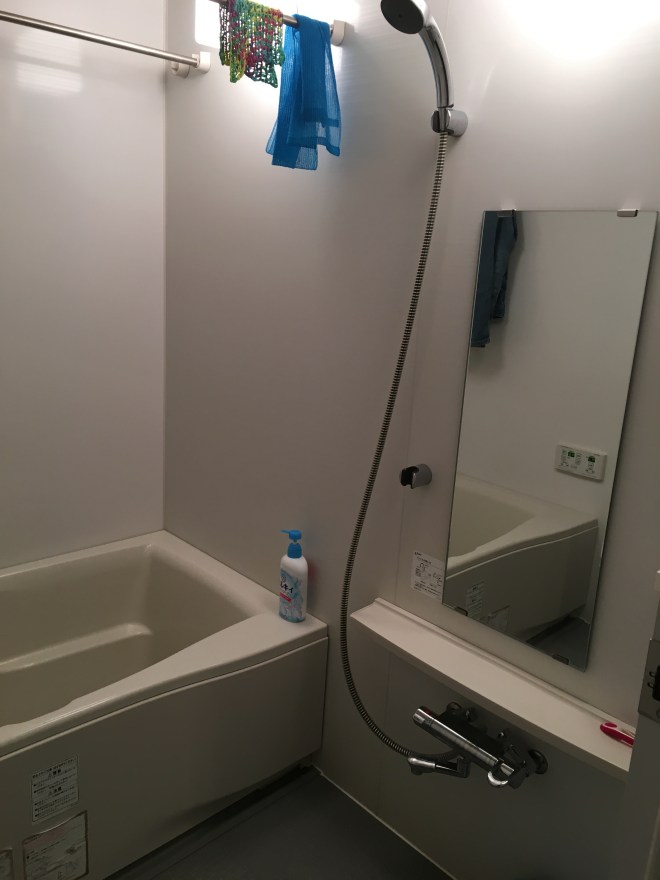
This is the shower in our apartment bathroom. It is actually its own room… fairly typical in size to a small bathroom. It is just off the sink/washing machine room, and has a watertight glass door. It has a tub, and a shower head, a mirror, and shelves for shampoos and soaps. But there, the similarity stops. This little room, is entirely the shower. The whole room — is the shower. It took me a while to get used to this idea. For the first few days here, I kept trying to climb into the tub and take my shower there.  The problem with that, was that the shower head was not over the tub area, and even when I swiveled the head as far as possible toward the tub, it still sprayed half in and half out of the tub area. Besides…  the tub surface was slippery, and was hard to stand in. The floor of the room is like a cushy non-slip mat. There is a drain hole ( at the bottom of this photo) on the floor, and under that cover is a screen to catch hair and debris to keep from clogging the drain.

2016-03-12b

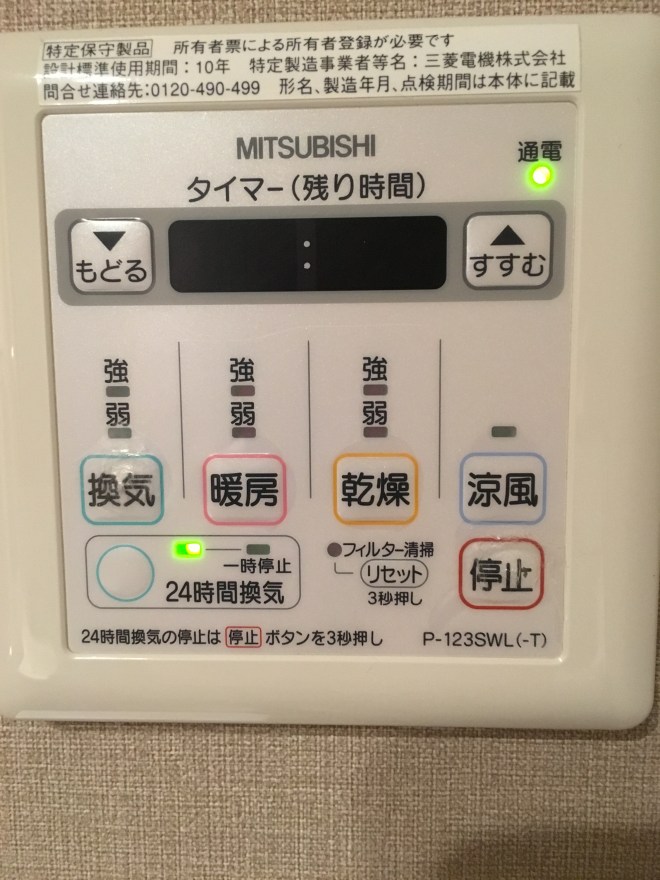
Outside of the shower room…  on the wall, is a small control panel. This controls the ventilation in the shower room. It has an automatic timer to set for the amount of time you want the air to circulate. Pink button turns on heated air, yellow button blows ambient air, and the blue button blows cool air. Red button turns the unit off. The air circulation is very important to keep the moisture levels from building up in the apartment, and to dry the shower area to prevent mold and mildew formation. It has been winter here since we moved in, so we usually turn on the heated air while we are using the shower, and then switch to ambient air afterward to dry the room. This system is also useful as a dryer for laundry when it is too cold, rainy, or windy to hang the clothes out on the balcony. Remember… we don’t really have a true clothes dryer here (see previous blog post.)

2016-03-12c

Traditionally in Japan, The tub is ONLY used for soaking. See the faucet on the wall? There is a faucet down which is usually used to fill a basin or small water tub with water. Traditional bath etiquette dictates that the bather sit on a small stool and wash with soap and water from the basin. Once the bather is clean, they rinse all the soap off with the hand-held sprayer, and then enter the tub to soak in CLEAN hot water. So the tub is actually used more like a hot tub. If you go to a traditional public bath in Japan, you are expected to bathe first, rinse thoroughly, and then you can get into the tub. No soap is used in the tub. Some apartments will provide a cover for the tub, so that you can save the water and use it again. This same water can be shared among family members…  just like sharing a hot tub.

2016-03-12d

Next to the tub is a small control panel for the water temperature, and to fill the tub. The right hand side displays the temperature for the tub, the left for the shower. Other buttons fill the tub, increase the temperature, lower the temperature (by adding cold water) and… there is a heat and recirculate button that will reheat water already in the tub.  We haven’t tried keeping the water and reheating it…  but that might be a handy feature to save the water for soaking. Mostly, we just use the shower. The few times we have used the soaker tub, though, were really nice. And yes… the controls are all in Japanese… I have to use my cheat sheet from the relocation company to know what each of those buttons is for.

2016-03-12e

The faucet flips up to divert water flow to the shower, and down, to turn the water on below. The left side of the faucet has another control for water temperature by mixing in unheated water. There are convenient shelves and a mirror — all of which end up getting wet with the shower. The whole room gets wet…

2016-03-12fThis is the all-important room dryer/heater/ventilator/clothes dryer on the ceiling of the shower room — and the bars from which we hang clothing and towels to dry. These bars are removable to be used on hooks in front of the balcony door, for optional fresh air drying in nice weather.
All in all, though this process has been strange to get used to, it is a fairly efficient use for bathroom space. It provides a traditional Japanese bathing experience, that has been easily adaptable to our western tastes.


Passport Saga, Part 2

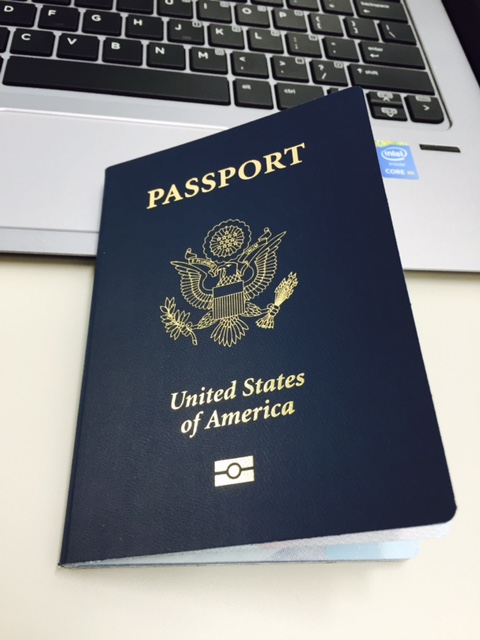
Passport cover

A few blog posts ago, I wrote with some trepidation about the need to renew my passport. Although it wasn’t set to expire for 2 years, I was running out of blank pages, and didn’t have enough for an upcoming trip. So, I made the trip to the U.S. Embassy in Tokyo, and watched with some distress as my trusty passport was packaged to be sent away for what was estimated to be a 3- or 4-week period for renewal.

Turns out my angst was unfounded. Just a week and a day after my venture to the Embassy, a package arrived. And there it was – a bright, shiny new passport, filled with blank pages just waiting for future stamps and visas. And my old passport…which still contains my current Japanese visa, by the way…was there, too, unscathed but for some strategically placed punches to show its retirement.

All in all, I must say I was surprised by the relative ease of the whole process. Yes, there are some specific instructions that you have to follow in completing the renewal application and getting the package ready to submit. And the process of going through security and getting to the passport window at the embassy was, not unexpectedly, a little tedious.  But all in all, the process was well-explained, straightforward, and it worked…even faster than promised.


Everyday life in Japan — Part 4

2016-03-07d

Toilet Talk…

I know I have already talked some about the amazing toilet technology in Japan, and maybe you are tired of hearing about it, but just one more post about it.

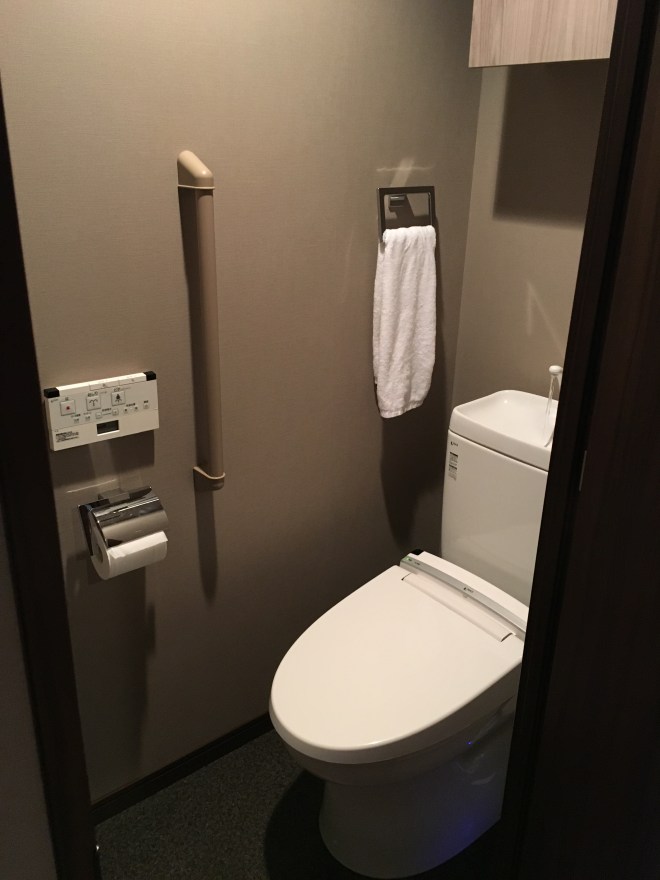
The above photo is the WC – water closet in our apartment. It is the first door you see as you enter the apartment. Technically in the genkan  (entryway) of the apartment. Most traditional Japanese homes will have a separated bathroom:  the toilet in one room, and the sink (and usually washing machine) in another, and then a “shower room” generally near or in the sink room. I am not altogether sure about why this came about, but I think it probably has to do with keeping the clean areas away from the “dirty” areas. Hence…  our WC is just off the entryway to the apartment. The genkan is the area where you change your “outside” shoes for your “inside” shoes. It is very important here to not bring the outside into your inside.

This is a small little room, but not really unusual. Our house back in the US has a similar water closet in the master bath. Not a big deal, really.  The difference, though lies in the caliber of the equipment in this room. Never have I seen such fancy toilets in the US. Or anywhere else for that matter. These amazing toilets are at the pinnacle of toilet technology!

2016-03-07a

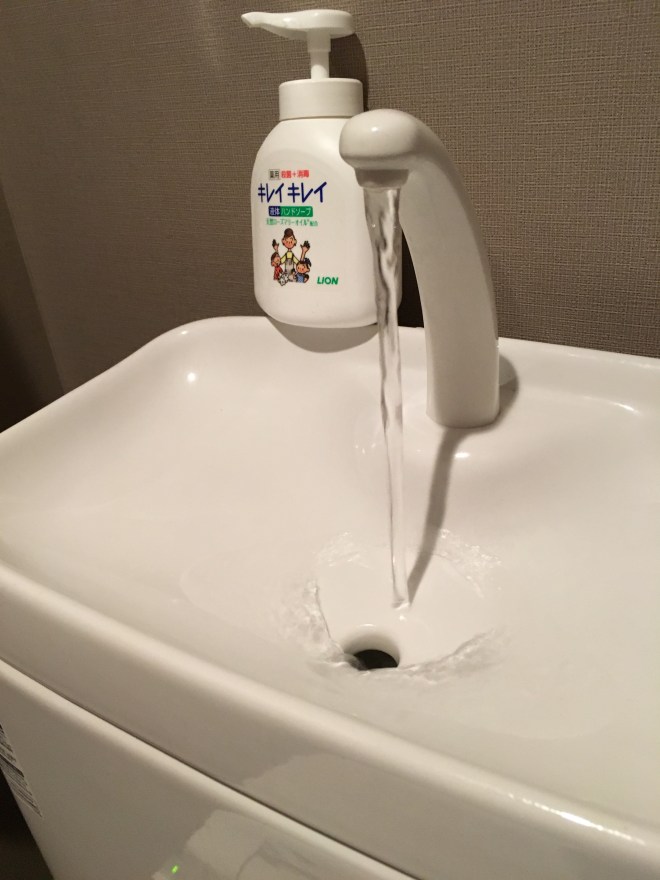
Now…  our toilet… the one in the above photo is by no means the fanciest toilet I have seen here in Japan. But it does have some nice features. The first thing you notice is the tiny little sink in the top of the tank. And yes… this is a nice feature when you consider that there is no free-standing sink in the room, and that the bathroom sink is in a completely different part of the apartment. It is nice to have a place to wash hands after using the toilet. Granted… the water that flows from the supply tube through the faucet is cold water, and there is no way to make it warm. But it does the job — and very efficiently too — as that same water just drains into the tank for the next flush. Soap and all. So maybe it also helps keep the toilet clean too?

2016-03-07c

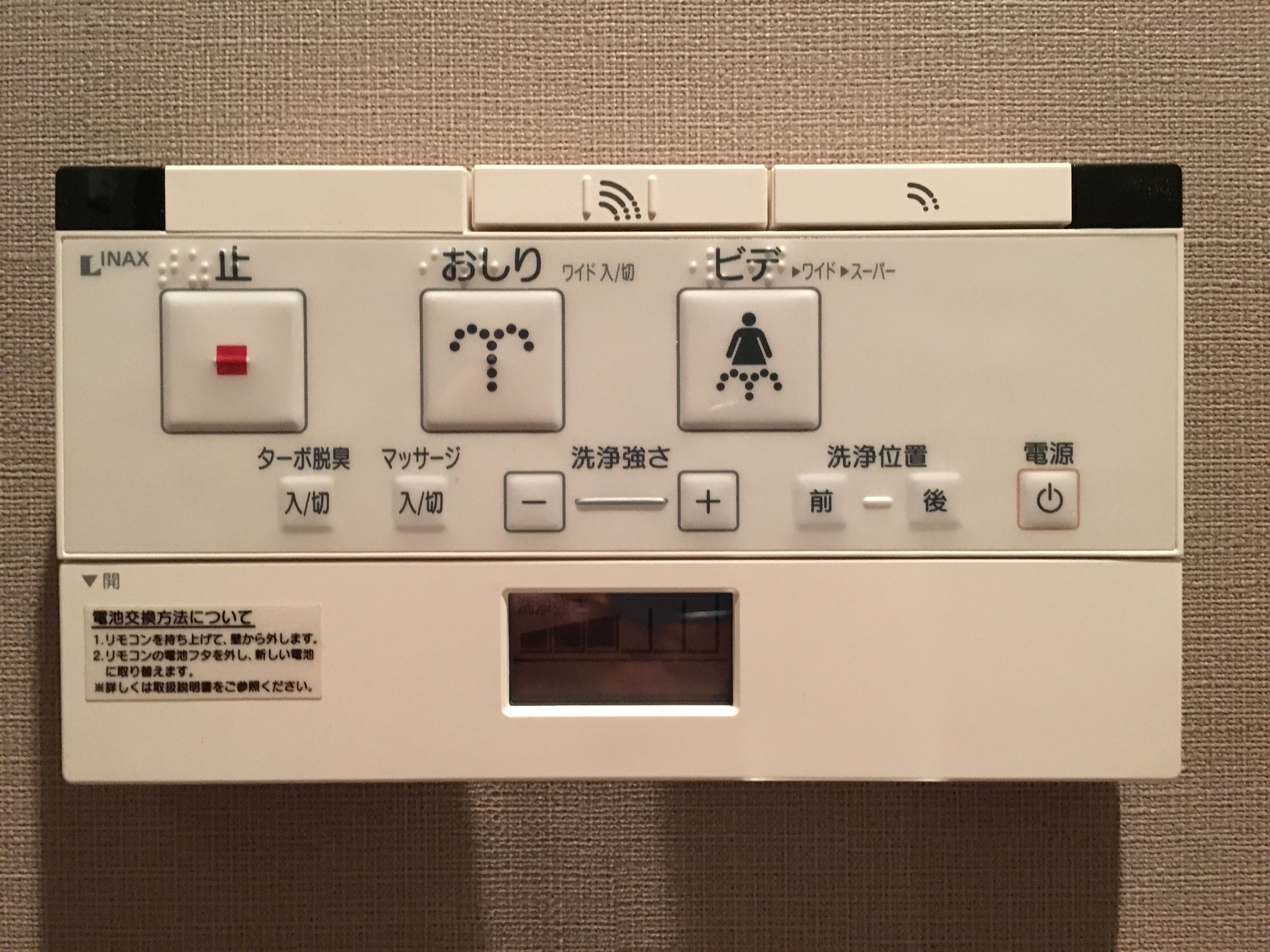
Ok…  The control panel on the wall. Yes… you can flush by using the little handle on the side of the tank, but you can also use the wall panel to operate the flush too. Big flush, or small flush…  you choose from the two buttons on the top…  graphics are obvious.

Other features include heated seat (very nice feature…  surprisingly nice feature…  something that I never thought I’d care about, but I really like it!), bidet, and a separate “backside” washer (for lack of a better name) — the difference is all about location. That is all I am going to say about that. And at the bottom, under the plus and minus is the control for the temperature of the water spray. After all… who wants to be sprayed with cold water… right? Also, when you sit down on the seat, the exhaust fan in the WC turns on… lol!

The other buttons I haven’t really used…  although I have the translations from the cheat sheet the relocation company left for me. As follows (the big red button just turns off the water spray)… Under the red button are two small buttons:  the left one is labeled “deoderization”, and the right one is labeled “massage” (massage???  lol…Not sure about that one.)  On the right side next to the power button are two related buttons labeled “position” presumably controlling the position of the spray. Haven’t tried out any of those…  Ahem.

2016-03-07b

This is what happens after a flush…  while the tank is filling, you have the opportunity to wash hands. I really like this feature because it seems like such a good way to conserve water. You can wash your hands in the clean water, but then that wash water is what is used for the next flush. Makes sense to me.

Other toilets we have seen here in Japan. Our hotel toilet had pretty much the same features as this one, but with one additional…  It would make water sounds when you sat down… to help drown out other sounds, I guess. The toilets at Haneda Airport have the same feature except that the water sounds turn on when you are in proximity to the toilet…  you don’t even have to sit on it to have sound effects. I have seen toilet cubicles at department stores that have water sound effects or optional music at the touch of a button. Plus, they have disinfectant wipes for the seat — and toddler seats mounted on the walls so that you don’t have to juggle your toddler while you use the facilities. Nice touch!

This last weekend, though, I think I saw the most unbelievable feature of all. We were at a restaurant, and when I went into the toilet, as soon as I locked the door, the lid of the toilet lifted. It was kind of creepy, actually, but I didn’t even have to touch the toilet at all. Then, the toilet flushed by itself, and the lid lowered as soon as I unlocked the door. Amazing. Weirdly amazing…lol. What next? I don’t know…  I am constantly surprised and fascinated here in Japan.

Everyday life in Japan — Part 3

2016-03-01a

Laundry. This is my combination washer/dryer. It sits next to the bathroom sink outside of the shower room. It came as part of the furniture/appliance rental package that we have here at our apartment. It is a decent size for the amount of laundry two people need to do, but I am still trying to figure out the best way to use it. Washing is not a problem, but drying is. The dryer function is not very efficient…  It is a top load machine, so it doesn’t tumble the clothes adequately to get them dry. Everything ends up damp and twisted, and wrinkly.

2016-03-01b

As you can see, the controls are all in Japanese — and Braille! — Neither of which I can read yet. We did get a cheat sheet from the relocation company that provided the translations of most of the buttons, but not all. It has been a bit of an adventure figuring it all out. The first time I used the dryer function, I couldn’t get it to work at all. It kept giving me error messages — which I didn’t understand. I finally figured out that you had to have the external door cover closed so that it can lock before it will run. It has two doors…  A door that closes over the tub, and an external door over that. Who knew?

2016-03-01c

So…  since the laundry usually doesn’t completely dry in the washer/dryer, I end up hanging clothes in the bathroom…  which is actually what most Japanese people do. They don’t really use clothes dryers much here. This bathroom unit has a “dryer” in the ceiling. It has a heat/ dry/ cool unit over the tub. We can heat up the shower room while we are taking a shower, then turn on the dry function when we are done. That dries the bathroom to prevent mildew, and dries any clothes or towels that are hanging over the bars. In the summer, the heat is turned off and it just blows air to dry the bathroom and the clothes.

Also… when the weather is nice, most Japanese people will hang clothes outside or in front of windows and doors to dry. Many apartments have drying racks on the balconies. Our apartment is up so high (on the 30th floor), that we can’t leave anything out on the balcony because of the risk of high winds blowing things off. I have hung towels and sheets out on the balcony on nice days, but I have to keep an eye on them so they don’t blow away. In our bedroom we have hooks from the ceiling so that we can take the hanging bars from the bathroom and hang clothes in front of the sliding door.

Anyway… I am slowly figuring out the best and most efficient way to get the laundry done here. I am so used to just taking clothes directly from the washer to the dryer, and I am not used to having damp clothes hanging all around. But… it is just another one of the little adjustments we have had to make… living here in Japan.

Food matters…

2016-02-29

This is our refrigerator/freezer. The refrigerator part is about the size of a college dorm room refrigerator, but it has a pretty nice sized freezer drawer underneath it. So far, I have plenty of space in the freezer — I haven’t bought much frozen food here — but the refrigerator part is pretty cramped.

Food shopping, food storage,  and cooking here are very different from what I am used to in the US. Obviously, the Japanese people have a different kind of diet and eat different foods from what most people eat in the US, but it goes much deeper than just the selection of food items in the supermarket. Everything is different.

Food packages are much smaller here. No “super economy size” here. Partly, that is due to this being an urban living environment. Most people living here in Shibaura do not have access to a car. We all walk  or take the subway wherever we go. Some people have little carts to carry their groceries and other packages. Some people ride bikes and carry their packages in bicycle baskets. some people carry everything in grocery bags… which is what I have been doing so far. And, I have found, that pretty much I can only comfortably carry about 2500 yen-worth of groceries at a time — less than $25 worth. So, it is nice to have the small packages because they weigh less, and they take up less space in my tiny refrigerator and cupboards. I have to be careful not to overload my shopping basket, or I struggle to carry everything back to the apartment.

So — it means that I have to shop much more frequently than I am used to. Living in US suburbia, I shopped once a week… twice at most. I stocked up on items when they were on sale. I bought larger sizes to save money. I had a nice big pantry to store things in. I would routinely buy $100 or more worth of groceries, load them in my car, take them home and I had plenty of space to store them. This is really different for me, and I am still feeling uncomfortable with the process… I feel like I am at the grocery store all the time!

Another difference…  Most people use cash here for smaller purchases. We have used the credit card at the grocery store, but most of the stores seem to prefer cash. At home in the US, I used plastic for everything. I rarely carried much cash. Now, when I shop, not only do I need to keep track of how heavy the items are so I can carry it all home, I also have to keep a running total in my head so that I am sure I have enough money to pay for everything. Grocery shopping used to be such a mindless activity…  and at times, it was very impulse-driven. I would buy stuff on a whim, not stick to a list, and buy what looked good to me at the moment. Now, I have to carefully consider each purchase to make sure I really need to buy it.

It hasn’t exactly been a problem…  Just a different way of doing things. I don’t mind doing it this way, but it does take some getting used to. I think we are eating healthier, because I seem to buy more whole foods and less processed stuff. I am buying different things — today I bought daikon, and leeks — things I rarely or never bought back at home. Also…  we are possibly eating less, because I prepare less. No room to store the leftovers.

I like the food here. We were mostly vegetarian back in the US, and it is very hard to eat totally vegetarian here — especially eating out. We eat fish here a couple of times per week. Tofu (which we enjoy) is very cheap here. And we eat more eggs here. (Side note — the eggs here are amazing! I have never seen such beautiful, rich, orange yolks! Yes… you CAN tell a difference. These eggs are delicious! Even buying the premium $4/ dozen eggs back in the US, these are so much better!)  There are things that we are missing from home, but mostly things that we are better off without anyway. We miss popcorn, peanut butter, peanuts, tortilla chips, and salsa. They sell these items in some food stores, but they are very expensive. I can’t find artificial sweetener  — and I will be happy to get used to not using that. Oatmeal, and other breakfast cereals are very expensive. I plan to load my suitcase with oatmeal when I am home for a visit.  Silly things I miss…  snack foods are very different here.

I wonder after we go back home, how many of these new habits will stick, or will we revert back as soon as we are there. We will see…  Tonight’s menu? Soba noodle soup, with egg and fresh shredded daikon, carrots and leeks. Yum.


A Sunday morning in Tokyo

Went for a walk on this Sunday morning. Today was the Tokyo Marathon. It is a flat 42- kilometer course. Walked about an 8-mile round trip through Shinigawa to Osaki and did a little shopping. Today is a blog of photos from the morning.

Lost in translation… again.

2016-02-25

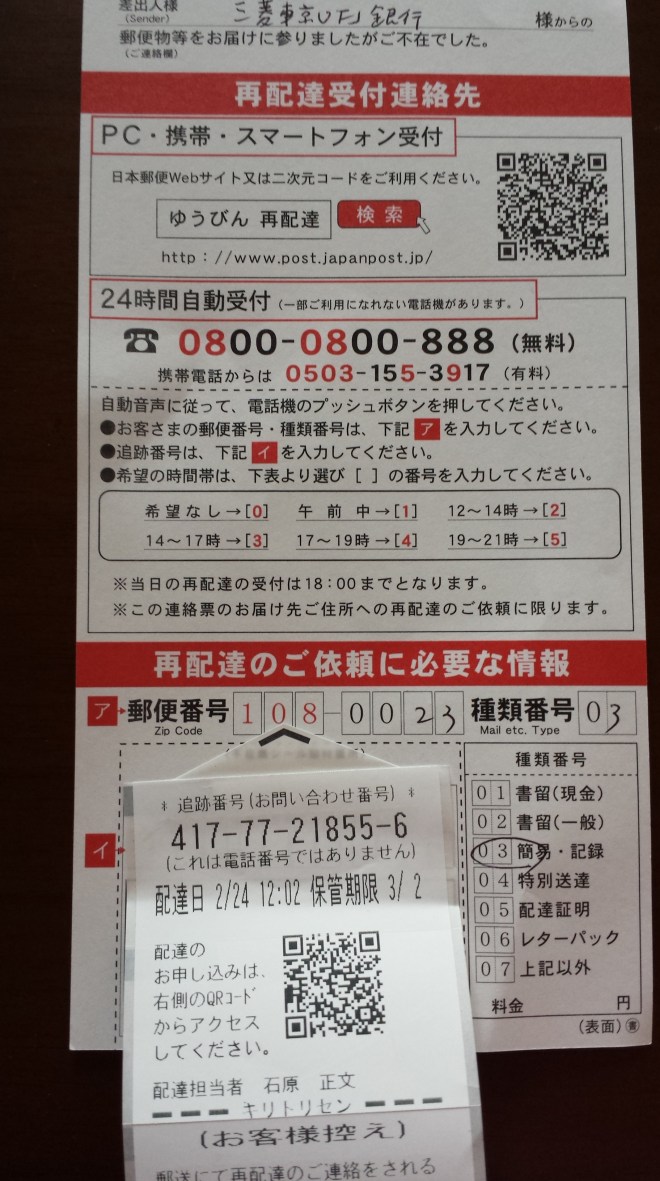
THIS arrived in our mailbox yesterday. And, of course…  because of our continuing lack of Japanese language skills, we had no idea what it was or what to do with it. Luckily, we have a concierge desk in the lobby of our apartment. It is only staffed during evening hours, from 18:00 to 22:00. The concierge also handles the dry cleaning service here…  my husband sent out his shirts for cleaning and pressing, and we had to go pick them up last night anyway, so we asked her about this notice.

It is a “failed delivery” notice…  Apparently they tried to deliver something that required a signature, and no one was home. The concierge speaks a little bit of English, and very kindly offered to call the number on the notice to schedule re-delivery for us.

I waited for it this morning… as required, and the mailman called our intercom from downstairs. I answered — in English — he responded — in Japanese…  I unlocked the door to let him into the lobby, and told him that I would come down. But, my dilemma was that then, I wasn’t sure if he understood me. Would he wait for me in the lobby, or would he come up to my door? There are 3 elevators… I didn’t want to miss him by going down in one elevator as he was coming up in another. Lol… So, I did actually wait a couple of minutes outside the elevator bank. I could hear the elevator coming up, so I hoped that it was him coming up to the 30th floor. And yes… it was. I met him as the doors opened, signed for our registered letter, and it was done. He was very nice, very polite, but again…  spoke no English. At least now I know that they DO bring the mail up to the door.

This language barrier sometimes seems so overwhelming. We have both been learning random useful phrases in Japanese. That has gotten us through so far, but we need to really start learning the language, and as I have talked about before, that means we need to learn the characters. We met with our Japanese teacher for the first time last night, and that is what she has started us on…  learning to read and write the syllabaries. Specifically, she started us writing the Katakana. 50 characters, and last night we worked on 15 of them. She gave us each a little practice pad marked off in squares, so that we could better draw the characters. I feel like a first grader again — practicing my alphabet. Lol…  This is hard!

I still feel like I need to be working on speaking the language, so I guess I will continue learning phrases for awhile. It is getting easier for me to read the words IF they are written in Romanji (the regular alphabet.) I at least have started to get used to the sounds of the Japanese language. It is getting easier to say the phrases I know, just because my mouth is getting used to the sound combinations that are unique to this language. I guess that is some degree of progress…  I think this might be a very long process.

Our Japanese teacher told us that there are usually so many Japanese people eager to practice speaking English, that we really could get by here in Tokyo without learning Japanese. I am not so sure I agree…  At least here in Shibaura, we have had many situations where the person we were attempting to communicate with spoke no English. And, we rarely see any non-Asians here in this part of Tokyo. At any rate…  I am in their country, and I feel like I SHOULD learn to speak their language.

Oh…  and that piece of mail we received? It was our ATM card from our new Japanese bank account. Unfortunately, all the instructions are in Japanese. I guess that will be the next hurdle to overcome.

Passport saga…part 1

In preparation for this assignment in Japan, I made sure to check my passport’s expiration date. Good through 2019, well beyond my expected return to the US. Another item checked off the get ready to go list.

What I didn’t check, however, were the number of blank pages left in my passport.  So when I recently found out I have a business trip in April to Russia, I started getting ready to apply for my visa. And found out that Russia requires two blank, side-by-side pages. I have one blank page and several partially blank pages…but that doesn’t meet the rules.

What to do? Well, it used to be that you could get additional pages added to a passport. But that ended at the end of 2015 with tightened security rules for passports. The only other alternative was to renew my passport.

I soon found that the process for an expat to renew a passport while living in Japan is pretty straightforward. Step-by-step process on the US Embassy website. Fill out the application form. Obtain a 2 x 2 photo (white background only). Obtain one self-addressed “Japan Post 510 yen LetterPack PLUS envelope.” Make a reservation to submit all of the above at the US Embassy’s passport window. Oh, yeah – bring a credit card or cash for the $110 application fee.

So today, my wife and I found our way to the embassy. Pretty easy subway ride, and a short walk to the embassy building. Cold wind though, and there was a surprisingly long line outside the embassy doors – mostly Japanese applying for visas. I was able to go in a shorter line for US citizens…but, since my wife didn’t have an appointment, she was – literally – left out in the cold.

Getting in the embassy is kind of like going to the airport. Take everything out of pockets. Belongings go through the x-ray. Walk through the metal detector. But then check my phone (and even my Microsoft band) at the desk. Can’t bring electronics in the embassy.

Once in, wait in another line to go through another security checkpoint. Then go inside and submit the appointment form at Window 7…and have a seat and wait. It is a crowded little room, with only two passport windows and several others for visa applications.

But the wait was short, and soon I was at the window talking with a very nice employee who, thankfully, spoke flawless English. My papers were in order and put in a file. Then it was off to the payment window to pay my fee and get a receipt, which then had to go back to the nice lady at the passport window.

All in all, a bit time-consuming, but the process seems to be pretty predictable. Now, if things work the way they should, I should have a brand-new passport with lots of blank pages, in about three weeks. More to come.