Laundry day.

2016-05-19

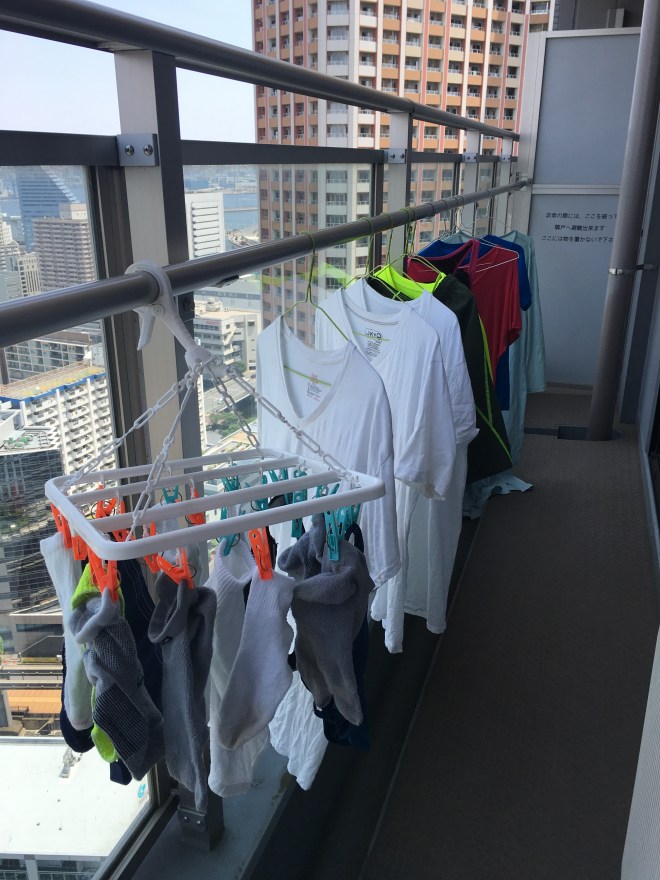
This was a good laundry day in Tokyo… The sky is clear, the sun is bright and the wind is brisk. Before I came to live here in Tokyo, I never considered the weather when I needed to do laundry. I always had access to a clothes dryer. My mother had a clothes dryer… at least from the time I was a young child. I never had the experience of hanging clothes out to dry… until now.

Most Japanese — at least in this urban area where we live — hang their clothes out to dry. It is almost a universal practice from the looks of the balconies around where we live. In fact, one would assume that clothes drying is the only reason apartments have balconies. I never see anyone using their balcony for anything else except clothes drying. True enough this balcony we have is very narrow… one could hardly fit any patio furniture on it. And… so I am told… our balcony is too high up (30th floor), and the risk of high winds is too great to leave anything out on the balcony for very long. Laundry… ok. Anything else? Too dangerous.

My washer, as I have mentioned before, is a combination washer/dryer. It does have a drying function, but from frustrated experience, it is nearly worthless. It is a top load machine, and the drum does not tumble. I think it spends most of the drying time drying out the machine. The clothes all end up a damp, wrinkled, twisted mass at the bottom of the machine. The only practical use I have come up for it, is to soften clothes that have dried stiff on the balcony on a windless day. Yes… I have learned ( in 4 short months) the ins and outs of laundry in Japan, and the importance of having a nice breeze to help the clothes dry soft. Lol… this has been an unexpected learning experience.

It isn’t that clothes dryers don’t exist here. We actually did look at one apartment that had a clothes dryer. And… I would expect that many homes do have clothes dryers. Also… our apartment would have plenty of space for a stacked apartment-size washer and dryer. But, for some reason here in Japan, I think that having a clothes dryer is considered a frivolous use of electricity and resources. Who needs a clothes dryer when you have free use of the sun and wind outside, after all.

Convenience aside, I have found that I don’t really mind hanging the clothes out. On a day like today they have dried quickly. I can generally do a small load first thing in the morning, and everything is done and dry by noon. We will see how it goes during the coming “rainy season” — during June and July. I may not like it so much then.  I will have to hang my laundry in the bathroom under the room dryer. But for now… let the wind blow!

Eigo ga wakarimasu ka?

We recently signed up for Amazon Prime –Japan. We are Prime members at home in the US, and it seemed like a good thing to do here.  We use Amazon all the time back home… it is just so convenient shopping online and having things delivered right to the door. We have used it before here, but had always been home when they brought a package. They buzz from downstairs and we let them in and they ride the elevator up to the 30th floor and walk the package to our door here.

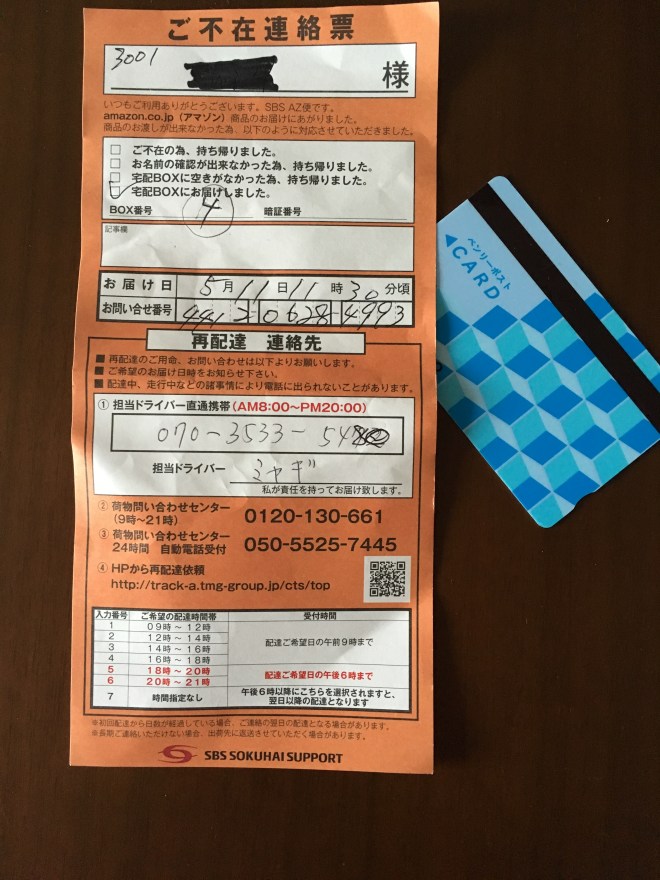
So — when you are not home when they deliver a package, they can leave it in a secure drop-off locker downstairs in the lobby of our building. There is a magnetic card you are supposed to use to open the appropriate locker to retrieve the package. This all sounds like a great system, but we have never had to use it until today. I was not home when the package was delivered, and when I checked the mailbox upon returning, I found this delivery notice.

2016-05-11(1)Prominently displayed on the notice was the phone number. So… I assumed I needed to call them to have the package redelivered. I used Google translate to translate the Japanese associated with the phone number, and found that it was the driver’s direct number. So… I called it. I even told him my name and address in Japanese. We actually communicated…  He understood what I said. But… that is where the productive communication stopped. I didn’t know how to say the things I needed to say to ask him to redeliver my package. I finally asked him: Eigo ga wakarimasu ka. Which means “do you know English?” He said “Hai, Hai” (yes, yes), but continued to speak to me in Japanese. We were getting nowhere. It wasn’t his fault…  It wasn’t my fault. It was just another instance of Japanese-American non-communication. It happens all the time. So, finally…  I thanked him (in Japanese) and hung up.

Not-so-prominantly displayed on the notice is the number 4 — I circled it. As I thought about it, I began to wonder about the locker downstairs. The man kept saying “4, 4” when I talked to him.  Hmm…  I dug around for the previously unused locker card, and decided to see if the package was downstairs after all. Unfortunately…  when I went to the locker, all the instructions were in — yes — Japanese. I played with it for awhile… The screen actually displayed our apartment number (3001), so I knew I was on the right track, but, for the life of me, I could not figure out how it worked. Fail.

That evening we showed the notice to the concierge (she is only here in the evenings) and she showed us which button to push to activate the card to open the locker. “Click”… the door opened,and there was our package. Simple. Sort of. If you know the language.

Nihongo ga wakarimasu ka. (Do you know Japanese?) No… Yes… but not much. Watashi wa Nihongo ga sukoshi wakarimasu. (I know a little bit of Japanese.) Still not enough to communicate effectively, but more than I knew 4 months ago! Progress!

Where is “Home”?

Where is “Home?”
2016-03-10a
We are on the way back from a week in Georgia. For the last 20 years, Georgia was our home. We raised four children there. We have adopted the trees, the hills, the Big Chicken, and even the awful Atlanta traffic as our own.

But now, strangely, I have to pause when I think about what is “home.”

This was our first trip back since mid-February. Since then, one of our daughters has moved into our house. She is doing a fine job keeping it up, and we are glad she is staying there.

That said, it is a very strange experience coming back to our house as a “guest.” The house is ours…all the things inside are ours…and yet, it isn’t now our “home.” It is something different.

After we moved to Tokyo, it took a long time to think of our apartment as our “home.” I had a hard time referring to it as “home.” I called it our apartment…our place…just about anything else.

But as time has moved on, I find myself more and more thinking of our tiny apartment in Tokyo as “home.” It doesn’t have much of our stuff there. It certainly lacks many of the comforts of our house in Atlanta. And when we walk down the street, we have trouble communicating with 90 percent of the people we see.
And yet, this little place on the 30th floor in a building on Shibaura Island now feels like home. It is where we live. Where we are together.

Maybe that’s one of the lessons we’re supposed to learn from this experience. Home is, as the saying goes, where you make it. We have a lot of things and a really nice house in Atlanta. But for now, that isn’t “home.” Our home now is in a foreign land, thousands of miles from where we were born and in a place that is very, very different from what we are accustomed to.

Our home is now in Tokyo, Japan. In a couple of years, that will probably change. But today, we are going home. And that, strangely, seems to be the right thing to do.

Home in Tokyo — 3 months.

Time flies — and we have been here in our Tokyo apartment for three months already! Things don’t seem so strange here anymore. In fact, the “strange” thing is how normal things are starting to feel here. Despite the fact that we don’t speak much of the language… and that we look different, dress (somewhat) differently, and come from a completely different culture, we are feeling pretty comfortable here. Human beings, apparently, are adaptable creatures. Given the basics, we can pretty much figure out the rest. Yes — there are still difficult things living here, and difficult days, and days when we feel homesick for things back home, but for the most part, we really like it here in Japan. We have settled into a nice routine. Some things…

  • The sun comes up really early here. We have sliding doors to the balcony in the bedroom and the living room. We have drapes on those doors, but we love to see the lights of Tokyo, and the Tokyo Tower at night, so we always leave the drapes open when we go to sleep. Then… when it starts getting light at 4:30 in the the morning (yes… it does!) I wake up. I can usually go back to sleep until 5:30 or so, but pretty much we are up by 6am. I don’t mind getting up early when it is light out.
  • We walk A LOT here. No car. I miss my car…  for the places I could go with it back home. But I don’t miss having a car here. Does that make sense? I love my car… but I don’t need it here. I like to walk, and I can take the subway anywhere I need to go in Tokyo, and a train to anywhere I need to go in Japan. I am enjoying the walking (and running) here in Tokyo. Our part of the city is very residential (even with the high-rise apartments all around.) There are lots of parks and schools and lots of families and children. Not really what you’d think about living in a huge city. In the US, it seems that most families with children move out to the suburbs… but there are families all over the place here!
  • Grocery shopping doesn’t seem so weird anymore. I go to the supermarket almost every day (you know…  I have a really small refrigerator.) I have a routine list of things I buy. Yes… it is different from what I buy in the US, but we have adapted our diet to living here in Japan, and eating more like they do here. I miss some foods from home, but less than I thought. The food here is wonderful. We are enjoying trying new foods here. You have to give in to the culture…  It would be much more frustrating trying to find the ingredients for our usual US diet here. Again… the food is wonderful here. Yum. (Except for the natto. Yuck.)
  • Shopping can be a challenge — depending on what you are looking for. There are so many shops and department stores here, but nothing (that we have found yet) equivalent to Target. I miss Target. I miss having a place to buy… everything-I-need-all-in-one-place. Here, I have to go to lots of different stores to buy things I need. Right now, I am looking for potting soil for container plants for my balcony. I have no idea where (close enough to carry home) to buy it. We have Daiso stores here that are roughly equal to dollar stores back in the US, but some of their merchandise is a little… cheap, and they don’t have everything I need.
  • We do have online shopping…  and Amazon.jp is great, but even on the “English” site, there is still a lot of Japanese to wade through. We are now “Prime” members on Amazon.jp, and they do have fast and efficient shipping. Target has a JP site now too, but I haven’t tried it yet. Receiving packages here is a little different… there is no UPS here. The delivery person rings from down at the entrance to the building, and I have to let them in (remotely.) They come up to our door, and I have to sign for every package.

And, lastly…

  • Money. Money issues have probably been the most frustrating things we have dealt with here. Mostly because our US bank and credit card companies don’t communicate with our Japanese accounts. There are so many financial hoops to jump through here. But we manage. Day to day, the thing that was hardest to get used to was carrying cash and paying almost everything with cash. Back in the US, I rarely carried much cash, and paid almost everything with the credit card. Japan is (strangely — considering they have so much technology) very much a cash society. I did not expect this. We use the credit card rarely. And I have to make sure when I shop at the supermarket that I have enough cash to pay for it. I know I could use the credit card if I needed to, but most people here prefer to use cash.

So… Three months into this assignment, we are doing fine. Last week we were in St. Petersburg, Russia, and I got to meet some other expat spouses (with my husband’s company.) We all compared notes about what it was like living abroad in our respective countries. We all talked about how hard it was to arrange everything and get settled, but most everyone in the group was happy about their expat experience. Some — who were finishing their time, and preparing to go back home — lamented that their time was almost up. I expect to feel that way at the end of two years. Yes… it will be nice to be home, but yes… I think I will miss my “home” here.


On Meiwaku… and other things…

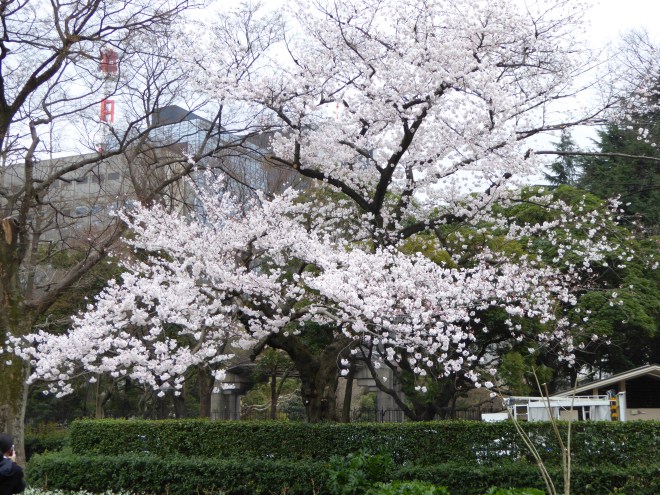
First off…  Spring has arrived in Tokyo. It isn’t always warm as I would like, but we have had some nice days. Above are some of the flowers and trees I see in my walks and runs along the canals here in Shibaura. The sakura trees are past their peak now and “snowing” blossoms all over the place.  The Japanese actually use that phrase to describe it, and there are “drifts” of blossoms piled up in corners and under all the trees. The wind blows them around and into the canals where they float on the water, and presumably out to sea. The azaleas are just starting to pop, and so are the dogwoods. The white dogwoods seem to be a bit behind the red ones that are already fully opened up.

Everyone here loves the springtime, and every weekend there are festivals and gatherings in the parks. Last weekend we found a food festival in Hibiya Park, near the Imperial Palace. Vendors of all kinds…  Japanese street food is awesome, and we found some really good craft beer there as well. (North Island Beer on Hokkaido!!!) Everyone spreads their blue tarps on the grass and spends time eating and drinking and enjoying time together. It is an amazing sight to see the tarps spread edge to edge and crowded with people.

I haven’t written a blog post in awhile, and there are several reasons why…  For one, things just don’t seem so weird and unusual here anymore. We are feeling much more comfortable in our new home, and blog topics just don’t jump out at us as much. It reminds me of when we first moved to Atlanta from the midwest. When we first got to Georgia we couldn’t stop staring at all the big tall trees. Where we had come from in the midwest, it was pretty flat and treeless. In Georgia we were surrounded by 80 foot pine trees. We stared at them for months. It all seemed so strange. And then… after awhile, we stopped noticing them. It all became so normal. And now, this “strange” place isn’t feeling so strange anymore.

For number two, I am trying to devote more time to studying Japanese. I may be feeling more comfortable in my new surroundings, but I still can’t speak much of the language. I still stumble over the most basic of phrases, and I just haven’t developed my ear for Japanese. I have to get better with this language! Then, number three, we are getting ready for another travel time. Next week we will be in Russia, then back here for a week, then “home” to the US for our daughter’s graduation. It will be a busy few weeks.

So…  on to the real topic of this blog post… Meiwaku. This is a cultural characteristic that we have noticed here from the very beginning, but have had trouble fully understanding. Finally, I found some information and an actual name for it. Meiwaku is defined generally as “being a nuisance to others.” The Japanese people are all about avoiding meiwaku! In everything they do, they are so careful to avoid being annoying or a nuisance to other people around them. You notice it everywhere. No one talks in elevators, or on the subway trains. When they do street construction, they always have someone posted on the sidewalk to direct pedestrian traffic, and they always bow politely and point the way through the construction. Even walking down the street, people will rarely look at each other as they pass, rarely greet each other, or even smile… and they aren’t being unfriendly. They are trying to be… unobtrusive.

One article I read explains it this way…  Imagine taking half the population of the US and putting it all in California. Then, crowding that population into only 20% of the land mass of California. That is Japan. So, with so many people crowded into such a small amount of space, in order to get along, they have developed a culture centered on cooperation and harmony. Somewhat like the Golden Rule, Japanese people try NOT to do to other people what they would not like to have done to them. Everyone is very careful to stay out of your “personal space,” including your personal business. Here…  we live our lives in our personal bubbles, and try not to “bump into” each other and annoy each other. “Sumimasen” is a word that is used frequently in the Japanese culture. It means “excuse me,” but it is used in greetings, and as a way to apologize for any potential instance of meiwaku. It is so different from the brash and “in your face” culture of the US. I kind of feel like the US could take a few lessons from the Japanese as to how to treat one another.

There are rules against too much noise in homes and apartments. Some apartments won’t allow musical instruments, or barking dogs…  and though I haven’t seen it in writing, noisy activities like vacuuming and laundry should not be done late in the evening or at night. My Japanese vacuum cleaner has a “quiet” mode. Living on the top floor of our building, we never hear noise from our neighbors…  in fact we have never seen any of our 30th floor neighbors. The only noise I hear is the elevator… and that because we are on top of the building right under the elevator mechanisms. It is amazing to me actually that we live in the largest city in the world, and our little part of Tokyo is so quiet and peaceful. I kind of like it . Meiwaku…  we should all try to avoid meiwaku.


Japanese veggies…

It is an understatement to say that grocery shopping has been an adventure here in Japan. Not only is most of the packaging written in Japanese characters that I struggle to understand, but I find a completely new bunch of products to choose from. The Japanese diet is very different from the typical American diet. The grocery store that I shop near our apartment, has a good selection of foreign products, and I can usually find most of the things I want… at least with a little bit of searching, and sometimes some help from Google Translate. Still…  and I find this most strikingly with the produce section… I have had to adapt our American diet to Japanese products. Particularly with the produce, the items I would typically buy in the US are either hard to find, or ridiculously expensive. For instance, tomatoes are plentiful and available here, but pricey! Apples are also expensive, as well as bell peppers, and strawberries.

Being a somewhat “adventurous eater” anyway, I really don’t mind trying all the different veggies I have found in the produce section. Here, following, are a few of my discoveries:

IMG_0183Chinese Cabbage — I know it is available at home, but I never bought it. Here, it is more common than lettuce, and used for many more things than lettuce ever is back home. Lettuces are harder to find, and again… more expensive. I buy Chinese cabbage and use it for salad, in soups, and other cooked recipes. It has a good texture — crunchy for salads, and still holds up when cooked. It has more umami flavor than lettuce (more about umami in a later blog post.) In the photo, I am holding just a quarter of the cabbage. My grocery store cuts and packages larger veggies into smaller portions…  They know we all have tiny refrigerators.
 

IMG_0184


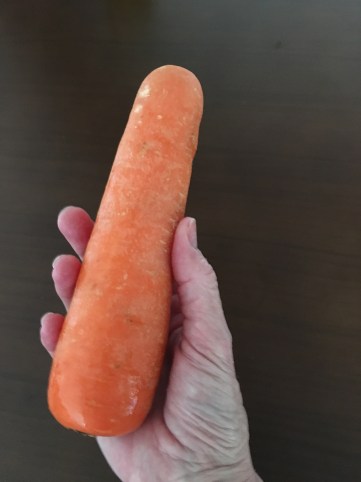
Yes…  This is just a carrot. I use them all the time back home. The reason I even talk about these is that they are so large here.  Here, I buy carrots individually, or in packages of two or three. These carrots are awesome! I found a great little slicer gadget at the Daiso (100 yen store) that will slice this beautiful carrot into almost paper thin slices! I use them for salads, soups, everything. Oh…  and strangely, ( I never would have thought it) carrots are also on that list of foods high in umami flavor. Guess that is why carrots are so popular, and such a common snack food item everywhere.

IMG_0185


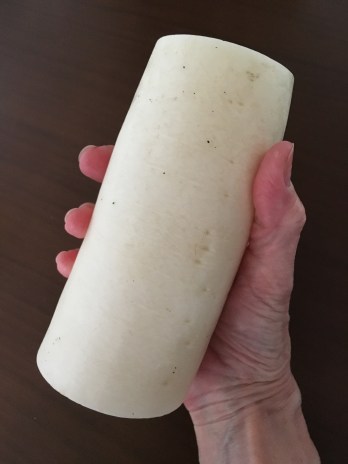
Daikon radish. Another thing that you can get in the US, but that I never purchased before I came here. Daikon radish is very popular in Japanese cooking… mostly grated raw as a condiment, or thinly sliced on salads, or with sushi. The photo shows only part of a daikon radish. The whole thing would be too big for my refrigerator. Seriously… the whole daikon radish is about 12 to 15 inches long. Beautiful, pure white flesh with a mildly peppery radish flavor. My husband won’t touch those little red and white radishes back home, but the daikon has such a mild flavor, he has started eating it here. The noodle shops here often grate it raw on top of soba or udon noodle soups. Very tasty.

IMG_0186

IMG_0188IMG_0189Japanese sweet potato. These are purple-skinned with a pale yellow flesh. The flesh is very dense and has a tendency to be somewhat dry when roasted. It has a nice sweet taste similar to the orange fleshed sweet potatoes in the US. Street vendors sell these here in Tokyo. Small trucks park on the side streets selling these, hot and roasted, and ready to eat. A filling and nutritious snack to eat as you walk along the street. I zap these in my microwave, then wrap them in foil and finish them off in my fish grill. We eat them skin and all with butter and salt, or with soy sauce. Also good dipped in a mixture of soy sauce and honey. French fried, they are a popular street food, sprinkled with sugar.
 

Shiso leaves. This small package of shiso leaves — about 6 or 8 leaves in this package — sells for about 70 yen in my grocery store. I first saw shiso leaves at a sushi restaurant right after we moved here. They sometimes put the wasabi on the shiso leaf, or the shiso will be used as a pretty garnish on the plate. I think that some people who see these think that it is just a garnish like parsley, and is not really meant to be eaten. Here… anything on the plate, is a food that can, and should , be eaten. Shiso has a somewhat bitter peppery flavor, and is a good compliment to sashimi and sushi, and sliced thinly is good on salad or as a topping for noodles.

IMG_0190


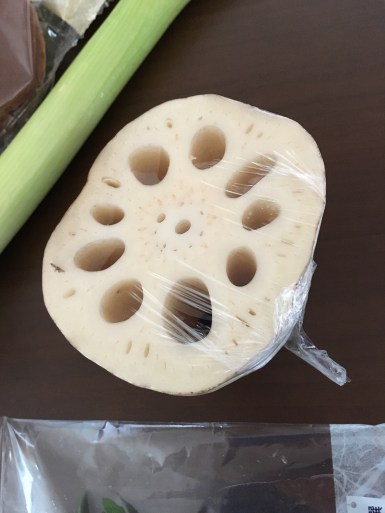
Lotus root. The edible rhizome of the aquatic lotus plant, it has a rather bland flavor, but has a nice crunchy texture. It comes packaged tightly in plastic to keep it from discoloring. It generally needs to be peeled and blanched to keep the nice white color, but then is good added to salads, or to soups and stews. the longer it is cooked, the starchier it tastes, but it still maintains a nice crunchy texture. I have added it to curry, and used it as a salad. It tends to take on the flavor of whatever it is served with. It is high in fiber, and is said to have many health benefits.


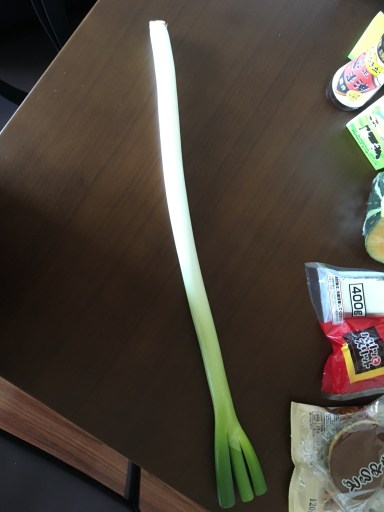
Japanese long onion. These things are very large, and very popular in Japanese cuisine. When I first saw them in the store — sold individually or in bunches of two or three — I thought they were leeks. They are like the small green onions we have back in the US, only HUGE! They can be thinly sliced and added to salads or soups, or as a condiment for sashimi or other raw fish, but they have a rather strong onion flavor. When sauteed or otherwise cooked, they become a little milder and sweeter. I have to cut these in half to get them to fit in my refrigerator, and I use the whole thing… white and green parts.

IMG_0191


This last one is a Japanese pumpkin. Also known as a kabocha squash. It is sold in small pieces too, and is usually thinly sliced and steamed lightly to be added to salads, or stewed with other vegetables and meats, or in a curry. It has a denser, sweeter flesh than pumpkins back in the US, and holds together well in a stew. Very tasty, and eaten with the outer rind on it.

I am interested to see how the selection of produce changes as the seasons change. I am hoping that some of the things that are really expensive right now, will become more reasonable in price through the spring and summer. We are enjoying trying these new foods, and don’t really miss the produce we had back in the US. At least not too much… yet. There are foods that we do miss… things that are not commonly available here… like peanut butter… and, they don’t eat much cheese here…  But, oh well… we will manage without for now.


“Mama said there’d be days like this…”

Some days here are just harder than others. Please don’t misunderstand…I am still excited to be living in Tokyo, and happy to be here. But… some days I just want to go home. Home to the familiar… home to my house, my kitchen, my garden, my pets, and most especially… my family. Yes… some days I just feel a bit homesick. The frustrations of dealing with a new country and a new culture, and the frustrations of not being able to communicate adequately, and clearly in this language just build up to the point I feel overwhelmed.

Yesterday — and carrying over into this morning — was one of those times. It hasn’t been any one major problem, but just a lot of little things that have been nagging at us for days. For instance… we finally set up an Amazon.jp account so that we could order some things that we need. We use Amazon all the time back home. It is my favorite way to shop, but we were not sure how we would receive packages in this high-rise apartment. We don’t have a full-time concierge in our building… if they deliver a package while we are out, it is supposed to go into a secure locker where we pick it up later. Well… the package we were awaiting arrived Saturday morning, and we were not here. The package, however, was too large for the locker, so they left us a re-delivery notice — in Japanese. So Sunday morning (no Easter Sunday holiday here!)  we called the number, and very painfully tried to communicate with the delivery company.

Please don’t believe it when people tell you that all Japanese people are ready and eager to practice their English… It just isn’t true. There are lots of people here who don’t know any English, and we still know very little Japanese (but, we are learning!) Anyway… we finally did get the message across, and rescheduled the delivery of the futon set (future blog post…) for our spare bedroom. It arrived promptly, and without further issue… mostly.

As we were accepting the delivery at our door, another person came to speak with us about signing up for NHK service. We have been in this apartment for two months now, and no one ever told us that we have to pay a TV fee here. Weren’t the relocation people supposed to take care of these things? Who knew…  In Japan anyone who has a TV, has to pay a fee to NHK — Japan’s national public broadcasting company. I know a lot of foreign countries do have television fees, but no one ever told us that Japan did…  and our relocation people never mentioned it.  The poor guy could not speak a word of English, and we were struggling to understand what he wanted…  he finally handed us a brochure (in English) and left in frustration. I am sure we will be hearing more from NHK soon…  Hopefully they can find someone who speaks English to help us set this up. I don’t have a problem with paying the fee, I just need to know how to do it. We rarely even turn on the TV because none of the channels have English. We mostly just use the TV for watching movies we brought from home. Anyway…  another communication challenge.

So… feeling somewhat in a funk about these things, and then missing my home and family at Easter/springtime, just put me into a dark and dreary mood. Kind of like the weather here this morning. The kind of morning when you just want to hide inside and stay in your PJ’s all day. But… *sigh*… I have found that when I get into that kind of mood here, the best thing for me to do is to get out and walk. And walk I did! 15,000 steps according to my fitness band… roughly equivalent to 7.5 miles.

I walked north toward Tokyo Tower, and finally ended up at one of my favorite places here… Hibuya Park, and the Imperial Palace. I saw cherry trees (Sakura)!

I saw ducks and heron at the pond and in the waters around the Imperial Palace. The ducks were mostly sleeping. It must have been a dreary morning for them too.

There was something big going on at the Imperial palace… They had streets blocked off and lots of police. There were also a lot of tourists… huge crowds of tourists. I avoided the crowds. I read later that they had opened up another part of the palace grounds for viewing of the cherry blossoms.2016-03-28n2016-03-28p

Back again through Hibuya Park, I found a Romulus and Remus statue — not sure why that was there — and some stray cats nibbling at the tender green grass.

2016-03-28q

And… one last look at a beautiful Sakura tree in full bloom.  After that, foot-sore and hungry for lunch, I hopped the subway back to Shibaura. Nice day, nice walk.

Yes…  life is full of frustrations wherever you go. Some days are harder than others. But it all feels so much better if you just get out there and deal with it.

Life is good.

Financial issues in Japan

One of the things I knew would be difficult is keeping up with financial issues while in Japan. Fortunately, my company provides an tax accountant for my US taxes, and another person for my Japanese taxes. That’s great…but there are other challenges.

For one, Japan is for the most part a cash society. In the US, I hardly ever carry cash. Everything goes on the credit card, and I pay the bill each month. In Japan, some places take a credit card…but for the most part, everyone prefers cash. For an upcoming trip to Russia for my company, we decided to havJapanese moneye my wife accompany me. Of course, the company won’t pay her air fare – that is my expense. I had my company’s travel agency book the ticket. When it was time to pay, I planned to use my credit card. But no, they prefer cash. A credit card is possible, but there is a 10% surcharge. So I’ll need to go to the ATM and get 130,000 yen in cash – about $1300 US dollars. Apparently that is a common kind of transaction in Japan…but something I would never do in the US.

Then there is the credit card issue. For tax considerations, I’m supposed to try to use one credit card for buying things in Japan, and pay that bill from my Japanese bank account. That would be fine, except my credit card is from a US bank. And it appears that there is no way to pay a US credit card bill from a Japanese bank. The two systems just don’t talk to each other.

So, the Japanese accountant says, apply for a credit card from a Japanese bank. My Japanese colleagues say the bank where I have my account is very difficult for a non-Japanese citizen to get a credit card. There are other banks. I haven’t yet applied, but from what I have read, the process ranges from difficult to impossible. We’ll see how that works out.

In the mean time, we are getting used to using cash. And coins. Lots and lots of coins. Its getting easier, but I still feel awkward digging around my pocket for the right coins to buy my groceries.

It’s an interesting contrast that this highly technological, advanced society resists the electronic financial tools that many other countries take for granted. It’s another of the differences I never expected when I moved to Japan.


Lost in translation… In the supermarket.

Triumph at the supermarket today! Lol…  I know, small things make me happy. These are two products I have been searching for these past couple of months since we moved to our apartment in Tokyo. And…  they were right in front of my face the whole time! Who knew?

I have had some difficulty stocking my Tokyo pantry because of the language issue here. When you move to a new place, you usually go to the store and buy staple products to have on the shelf: Flour, sugar, salt, spices, baking powder, etc.  And I have been searching high and low for cornstarch and baking soda, with no success… until now! Yes… the photos above show those two elusive products!

I have looked at that “Homemade Cake” package a hundred times, and just thought it was some sort of cake mix. I had no idea that here they use that to mean baking soda. And, even though I can now “read” the kana, those Japanese characters on the box would not have helped me one bit. The Katakana reads “ta n sa n,” which means nothing to me, but apparently means baking soda if you know the language. The two Kanji  characters above the Katakana does (by Google Translate) mean baking soda, but I don’t know the Kanji yet. I would never have even used Google Translate on this product, because I was sure it wasn’t the thing I was looking for. I finally googled it, and found another expat blog that talked about the same thing, and actually showed a picture of this product. Finally!

I bought “baking powder” weeks ago. It is very clearly labeled in English! I have no idea why some product names are written in English, and others aren’t. Flour was not too difficult because it had a picture of a loaf of bread. Sugar was a bit trickier because the bags of sugar were on the shelf right next to almost identical bags of salt! The only clue I had with that one was that there were pictures of fish on the package — presumably because it was “sea salt.” Confusing.

The cornstarch — the package on the right — I actually could have read with my rudimentary kana-reading abilities had I taken the time to look at this fairly nondescript little package on the top shelf of the baking aisle. It very clearly reads “ko-n su ta-chi” in Katakana. Oh Heavens!

It really is useful to be able to read the kana, although I am still very slow at it. I figure I am probably reading Japanese at about the kindergarten level right now. They do start their children out learning to read the kana…  Hiragana first, and then the Katakana. Learning the Kanji symbols comes later after they can fluently read the kana. Eventually I want to learn some of the more common Kanji. I read online today that newspapers at one time, were limited to using only 1850 of the most common Kanji symbols. I don’t know if that is still true, but even that number seems formidable to me.

I feel like I am making progress with the language here, but it is slow. These small successes along the way help keep me from feeling too overwhelmed. Lol… at least I now have cornstarch for the curry we are having for dinner tonight!


Rules of propriety…

Coming from the US, which is by and large an “anything goes” culture where people usually do and say and wear whatever they want, it has been an interesting experience integrating ourselves into Japanese society. Not wanting to be one of “those” Americans who seem to think that the rest of the world should conform to our standards, we have been very carefully observing the world around us. Certainly, in a sea of Japanese people, we can’t help but appear conspicuous, but we don’t want to be too “gaijin” either. Some observations:

  •  Women in Japan (aside from teenagers, or in areas with a popular nightlife, i.e. Shibuya) dress very modestly. We will see what happens in the warmer weather, but I haven’t seen any tank tops or camis, or low-cut and revealing clothing. Most women wear skirts or dresses for work — dark stockings for the winter. Skirt length is modest. I have seen leggings — and I own some myself — but they are worn under skirts or very long shirts. No tights, leggings, or even yoga-type pants without having something else to cover your backside. Which leads to the next…
  • Running attire for women… and even for most men… is tights, with shorts over the tights. I am sorry, but I really hate having to do this. But I do it. I feel a bit “naked” and conspicuous without the shorts. And, like I said… even most men do this. In warmer weather, most women still wear tights or capri-length pants with shorts over them.
  • Tattoos. Japanese people do not approve of tattoos. At least none that are showing. If you have a tattoo, you are required to cover it at most gyms. Apparently, tattoos are a part of Japanese gang culture. I think that the rules are easing, and more Japanese are getting tattoos, so I think this will eventually change. They are a fairly tolerant people, and probably wouldn’t ostracize a foreigner for having a tattoo, but still… gaijin.
  • Piercings. This almost goes without saying that the more outlandish piercings we see in the US  — tongue piercings, eyebrows, navels, etc. as well as earlobe gauging and such — are not considered appropriate. But I have also noticed that very few women wear earrings or have pierced ears at all. Jewelry is very modest here as well. I do think that this is another area that is changing, though. At least with the younger Japanese.
  • And… sunglasses. This is our third trip to Japan, but we have never noticed this before. Japanese people rarely wear sunglasses. I have seen cyclists and runners wearing sunglasses, but very few people walking the streets are ever wearing sunglasses. I googled it…  and the explanation (again) was that sunglasses are associated with Japanese gang culture. Also… another explanation was that their dark eyes have more pigmentation and, therefore, they can tolerate the bright sunlight better than me with my light blue Scandinavian eyes. Oh well… I still wear my sunglasses.

I don’t really want to dwell on the differences between “us” and “them”…  I don’t want anyone to think that these are major issues that we have encountered living here. Again…  the people we have met here have been nothing but gracious and friendly and accepting of us. I only mention these things because we really want to make an effort to respect their culture, and fit in as much as possible while we are here. These are just meant to be some interesting cultural observations. “When in Rome… “